Last updated: June 24, 2026
Protein Molecular Weight Calculator

Creators
Dharmendra SinghReviewers
Creators
Dharmendra SinghReviewers
Quick Answer
Protein molecular weight is calculated as the sum of average residue masses for each amino acid plus 18.01528 Da for the free N- and C-terminus. For example, the 21-residue insulin A-chain (GIVEQCCTSICSLYQLENYCN) is about 2,383 Da (≈2.38 kDa). This free calculator accepts pasted sequences or FASTA and falls back to the 110 Da/residue rule when only a length is supplied.
To find a protein's molecular weight, add the average residue masses of all its amino acids and add 18 daltons for the free termini.
Key Takeaways
- Protein MW = Σ average residue masses + 18.01528 Da (one water for the free termini).
- Use the full amino-acid sequence for accuracy; FASTA headers and unknown letters are ignored.
- A quick estimate is 110 Da per residue — about 33 kDa for a 300-residue protein.
- Average MW is what you compare with SDS-PAGE and most biochemistry references.
- Add post-translational modifications and purification tags separately if relevant.
Creators
Dharmendra SinghReviewers
Creators
Dharmendra SinghReviewers
Formula
MW = Σ residue mass(aa) + 18.01528 (one water for the free termini)
Where:
- MW=Molecular weight of the protein(Da)
- m_i=Average residue mass for amino acid i(Da)
- n=Number of amino acids in the sequence(residues)
- 18.01528=Mass of one water molecule added back for the free N- and C-terminus(Da)
Worked Examples
Insulin A-chain (21 residues)
The 21-residue A-chain of human insulin (GIVEQCCTSICSLYQLENYCN).
- 1Sum the 21 average residue masses from the lookup table
- 2Add 18.01528 Da for the terminal water
- 3Result: ≈ 2,383.83 Da (about 2.38 kDa)
- 4Average mass per residue: ≈ 113.5 Da
Quick estimate from length only
No sequence on hand — estimate a 300-residue protein using the 110 Da/residue rule of thumb.
- 1MW ≈ 300 × 110 Da + 18.01528 Da
- 2MW ≈ 33,018 Da
- 3≈ 33 kDa
- 4Useful for quick gel-migration estimates
Introduction
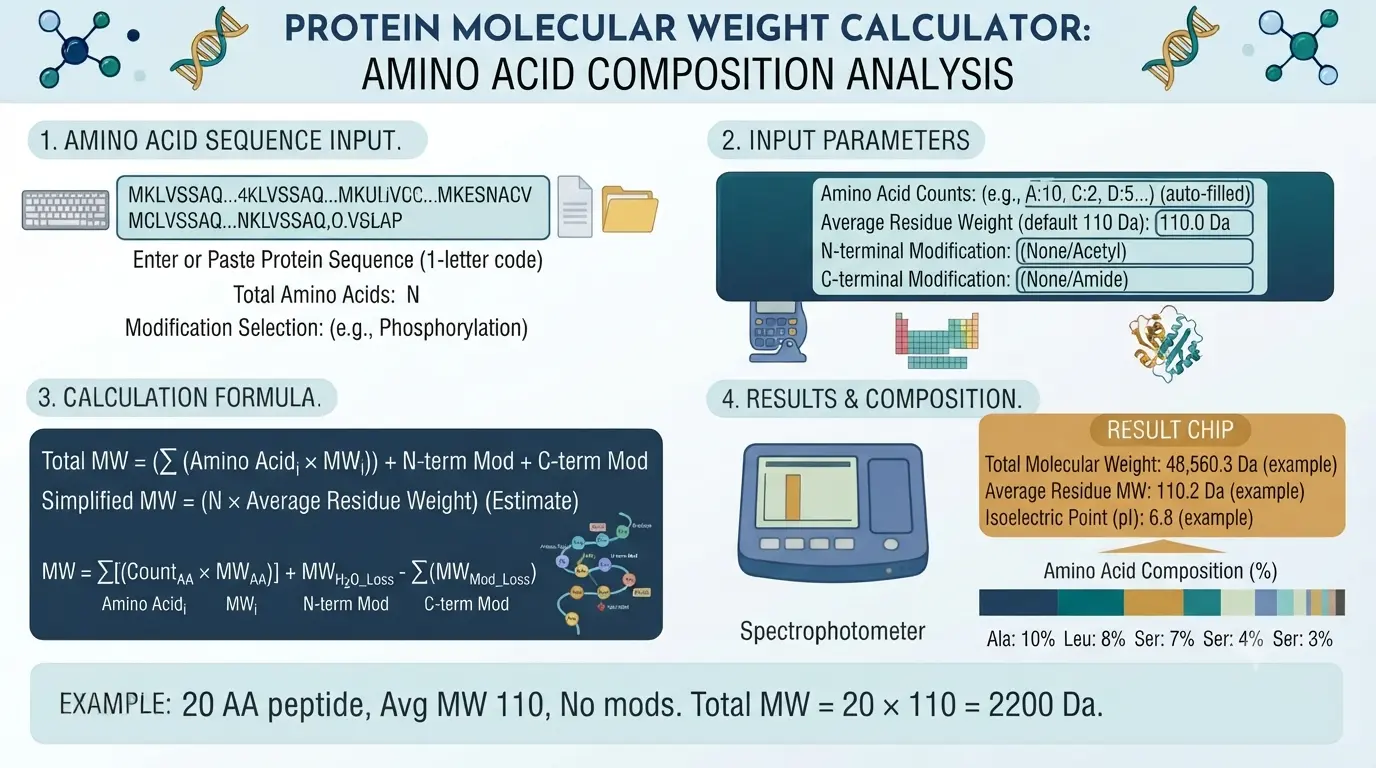
The Protein Molecular Weight Calculator computes a protein's molecular weight (MW) from its amino-acid sequence using standard average residue masses. Paste a one-letter sequence (e.g. MKTAYIAKQ...) and it sums the residue masses and adds one water (18.01528 Da) for the free N- and C-termini — the same approach used by ExPASy ProtParam. It reports the MW in daltons (Da) and kilodaltons (kDa), plus sequence length and average residue mass. If you don't have the sequence, enter just the length for a quick 110 Da/residue estimate. Use this with our protein concentration calculator to convert mass and moles.
How the Protein Molecular Weight Calculator Works
When two amino acids form a peptide bond, one water molecule is released — so the linked residue mass of each amino acid is its amino-acid mass minus water. The calculator uses average residue masses for the 20 standard amino acids and simply sums them along your sequence, then adds back one water for the free termini. The result matches the average MW returned by ExPASy ProtParam to within rounding.
Paste a one-letter amino-acid sequence
Spaces, numbers, FASTA headers, and unknown letters are skipped
The 20 standard amino acids each contribute their residue mass
One water (18.01528 Da) is added for the free N- and C-terminus
Result is reported in daltons (Da), kilodaltons (kDa), length, and average mass
Pasting a full FASTA record? The calculator ignores non-letter characters, so the header line is dropped automatically.
Average Residue Masses (Da)
These are the values used internally for the 20 standard amino acids. They are the standard residue (linked) masses — the amino-acid mass minus one water — as published in many protein chemistry references and used by ExPASy ProtParam.
| Amino acid | 1-letter | Residue mass (Da) |
|---|---|---|
| Glycine | G | 57.0519 |
| Alanine | A | 71.0788 |
| Serine | S | 87.0782 |
| Proline | P | 97.1167 |
| Valine | V | 99.1326 |
| Threonine | T | 101.1051 |
| Cysteine | C | 103.1388 |
| Leucine / Isoleucine | L / I | 113.1594 |
| Asparagine | N | 114.1038 |
| Aspartate | D | 115.0886 |
| Glutamine | Q | 128.1307 |
| Lysine | K | 128.1741 |
| Glutamate | E | 129.1155 |
| Methionine | M | 131.1926 |
| Histidine | H | 137.1411 |
| Phenylalanine | F | 147.1766 |
| Arginine | R | 156.1875 |
| Tyrosine | Y | 163.1760 |
| Tryptophan | W | 186.2132 |
The 110 Da/Residue Rule of Thumb
If you only know how many amino acids a protein has, multiply by 110 Da/residue for a fast estimate. This works because 110 Da is roughly the average residue mass across naturally occurring proteins, weighted by amino-acid abundance. The calculator uses this when you supply only the length field.
Quick MW (Da) ≈ length × 110
Accurate to about ±10% for most proteins
Useful for first-pass gel migration estimates
Less accurate for proteins enriched in tryptophan or glycine
Always prefer the full sequence when available
A 300-amino-acid protein is roughly 33 kDa — a band you'd expect to migrate near the middle of a standard SDS-PAGE gel.
Average vs Monoisotopic Mass
Proteins have two commonly reported masses. Average mass uses the natural isotope mix and is the value reported by gel migration, ProtParam, and most biochemistry references. Monoisotopic mass uses only the most abundant isotope of each element and is what high-resolution mass spectrometers report for small peptides. This calculator returns average MW, which is what you want for SDS-PAGE, Western blotting, and most lab calculations.
| Mass type | What it uses | Where it's used |
|---|---|---|
| Average | Natural isotope average per element | Gels, ProtParam, general biochemistry |
| Monoisotopic | Most abundant isotope only | High-resolution mass spectrometry of small peptides |
Average and monoisotopic masses differ by less than 0.1% for small peptides but can diverge by several daltons for large proteins.
Worked Example: Insulin A-Chain
The 21-residue A-chain of human insulin has the sequence GIVEQCCTSICSLYQLENYCN. Summing the average residue masses for each letter and adding one water gives approximately 2,383.83 Da, or about 2.38 kDa — within a fraction of a percent of the published value. Compared with a 110 Da/residue estimate (21 × 110 ≈ 2,310 Da), the sequence-based answer is more accurate by tens of daltons, because insulin is enriched in cysteine and tyrosine.
This calculator returns the reduced (linear) MW. The fully assembled disulfide-bonded insulin loses additional protons across its three disulfide bonds (~6 Da total) — usually negligible for gel work.
Why Protein Molecular Weight Matters
MW is one of the first numbers you need for nearly any protein experiment, from gel interpretation to dose calculations. It also feeds into derived numbers like molar concentrations and extinction coefficients.
- SDS-PAGE & Western blot:
estimate which band size to expect
- Concentration math:
convert between mg/mL and molar units
- Mass spec:
confirm the expected average mass of an analyte
- Cloning & expression:
predict the size of a tagged fusion protein
- Pharmacology:
calculate doses in moles for biotherapeutics
What This Calculator Does and Doesn't Include
The MW returned is the unmodified protein from the sequence. Post-translational modifications (PTMs) and processing change the observed mass and must be added or subtracted separately for an experimental match.
Glycosylation adds ~1–10 kDa or more per site (highly variable)
Phosphorylation adds ~80 Da per site
Methylation adds ~14 Da per site
Disulfide bonds remove ~2 Da each (two H atoms)
Signal-peptide cleavage subtracts the removed N-terminal sequence
Tags (His₆ ≈ 0.84 kDa; GFP ≈ 27 kDa) must be added to fusions
Common Protein MW Mistakes
Most discrepancies between calculated and observed MW come from sequence errors, missing PTMs, or comparing the wrong mass type. Watch for these.
Pasting a DNA sequence by mistake (only A, C, G, T appear)
Including the signal peptide that's cleaved in the mature protein
Forgetting purification tags (His-tag, GFP, MBP) on fusions
Comparing average MW to a monoisotopic value from mass spec
Using the 110 Da/residue estimate for tryptophan-rich proteins
Protein Molecular Weight Glossary
Key terms used in protein mass calculations. Understanding them helps when reading ProtParam output or mass-spec results.
| Term | Definition |
|---|---|
| Dalton (Da) | Atomic mass unit; 1 Da = mass of one hydrogen atom (~1.66 × 10⁻²⁷ kg). |
| Kilodalton (kDa) | 1,000 daltons; the common unit for protein MW. |
| Residue mass | Amino-acid mass minus one water (released when forming the peptide bond). |
| Average mass | Mass calculated using the natural isotope abundance of each element. |
| Monoisotopic mass | Mass calculated using only the most abundant isotope of each element. |
| FASTA | A plain-text sequence format starting with a '>' header line. |
| PTM | Post-translational modification (e.g. phosphorylation) altering observed mass. |
Quick Reference Card
Protein Molecular Weight — Quick Reference
Quick reference • Protein Molecular Weight Calculator
MW = Σ residue masses + 18.01528 DaValid range: 1 to 100,000 amino acids; standard one-letter codes (ACDEFGHIKLMNPQRSTVWY)
Common Values
⚠ Watch Out
- •Don't paste a DNA sequence — only A, C, G, T would be recognized
- •Include purification tags in the sequence to match the expressed protein
- •Calculated MW excludes post-translational modifications
- •Compare average MW with gels; monoisotopic MW with high-res mass spec
Pro Tips
- →Pasting FASTA is fine — headers and line breaks are stripped automatically
- →Subtract the signal peptide for the mature secreted protein
- →Add ~80 Da per phosphorylation site to match phospho-protein mass
- →Use the length fallback for back-of-the-envelope estimates
FAQs
How is protein molecular weight calculated from a sequence?
Sum the average residue mass of each amino acid in the sequence and add 18.01528 Da (one water for the free termini). The residue mass is the amino-acid mass minus one water, which accounts for the water released at every peptide bond — so adding one water back is correct for the linear protein.
Why is one water (18.01528 Da) added at the end?
Each amino acid is stored in the lookup table as a residue mass (already minus one water). When n residues are linked by n−1 peptide bonds, n−1 waters are released. Adding one water back accounts for the free H on the N-terminus and the OH on the C-terminus of the assembled chain.
What is the average molecular weight of an amino acid?
About 110 Da. The exact average depends on amino-acid composition, but 110 Da/residue is the standard quick-estimate value because it falls near the abundance-weighted mean of the 20 residues. The calculator uses this when only a length is supplied.
What does the calculator do with non-standard letters?
Letters that aren't part of the 20 standard amino acids (B, J, O, U, X, Z, etc.) are skipped. They don't contribute mass and aren't counted in the length, so a sequence like 'AXG' is treated as 'AG'.
Can I paste a FASTA sequence?
Yes. The calculator cleans the input by uppercasing it and stripping any non-letter characters, so FASTA headers, line breaks, numbers, and spaces are all ignored. Only the amino-acid letters are summed.
Why does my gel band run at a different size than the calculated MW?
Calculated MW is the unmodified linear protein. Apparent gel size shifts because of post-translational modifications (glycosylation, phosphorylation), charge effects in SDS-PAGE, disulfide bonds, or signal-peptide cleavage. Glycosylated and intrinsically disordered proteins commonly run higher than calculated.
What is the difference between average and monoisotopic mass?
Average mass uses the natural isotope mix of each element and is what ProtParam, gels, and biochemistry textbooks report. Monoisotopic mass uses only the most abundant isotope per element and is what high-resolution mass spectrometers report for small peptides. This calculator returns average MW.
How accurate is the 110 Da/residue estimate?
It's typically within ±10% of the true MW because 110 Da is roughly the average residue mass across natural proteins. Use it only when you don't have the sequence; the sequence-based answer is much more accurate, especially for proteins enriched in tryptophan (186 Da) or glycine (57 Da).
Should I include my purification tag in the sequence?
Yes — paste the full expressed sequence including any tags (His-tag, GFP, MBP, etc.) so the MW matches the protein that actually runs on your gel. Strip the tag only if your sample was protease-cleaved before measurement.
Does this calculator account for disulfide bonds?
No. Each disulfide bond removes about 2 Da (two hydrogen atoms) from the calculated linear MW. For most lab work this is well below detection, but high-resolution mass spec users may want to subtract ~2 Da per S–S bond manually.
Is the Protein Molecular Weight Calculator free to use?
Yes, the calculator is completely free with no registration required. You can paste any number of sequences to get instant MW values for cloning, gel work, mass-spec planning, or teaching.