Last updated: June 19, 2026
Cell Dilution Calculator

Creators
Dharmendra SinghReviewers
Creators
Dharmendra SinghReviewers
Quick Answer
The Cell Dilution Calculator uses the universal dilution equation C₁V₁ = C₂V₂ to find the volume of stock cell suspension needed to reach a target concentration: V₁ = (C₂ × V₂) / C₁, where C₁ is the stock concentration, C₂ is the target concentration, and V₂ is the final volume. The diluent (media) volume to add is V₂ − V₁ and the dilution factor is C₁ ÷ C₂. This free online calculator instantly returns the stock volume, diluent volume, and dilution factor for cell culture seeding, plating, flow cytometry, and serial dilutions.
To dilute cells, the volume of stock you need equals the target concentration times the final volume, divided by the stock concentration, and the diluent you add is the final volume minus that stock volume.
Key Takeaways
- Cell dilutions use the universal equation C₁V₁ = C₂V₂, so the stock volume needed is V₁ = (C₂ × V₂) / C₁
- The diluent (media) volume to add is simply V₂ − V₁, and the dilution factor is C₁ ÷ C₂
- You can only reduce concentration by diluting — if the target exceeds the stock, concentrate the cells first
- For dilution factors above ~20×, use a serial dilution to keep the pipetted stock volume ≥ 20 µL and reduce error
- Accurate cell counting (count viable cells in duplicate) matters more than the arithmetic for reproducible results
Creators
Dharmendra SinghReviewers
Creators
Dharmendra SinghReviewers
Formula
C₁ × V₁ = C₂ × V₂ → V₁ = (C₂ × V₂) / C₁
Where:
- C_1=Stock cell concentration(cells/mL)
- V_1=Volume of stock to add(mL)
- C_2=Target (final) cell concentration(cells/mL)
- V_2=Final total volume(mL)
Worked Examples
10× dilution of HeLa cell stock
A confluent T-75 flask is counted at 1×10⁷ cells/mL and you need 10 mL at 1×10⁶ cells/mL for seeding a 6-well plate.
- 1V₁ = (C₂ × V₂) / C₁ = (1×10⁶ × 10) / 1×10⁷
- 2V₁ = 1 mL of stock cell suspension
- 3Diluent volume = 10 − 1 = 9 mL of fresh media
- 4Dilution factor = 1×10⁷ / 1×10⁶ = 10×
2× dilution for plating CHO cells
A CHO suspension counted at 2×10⁶ cells/mL must be halved to 1×10⁶ cells/mL in a final volume of 4 mL.
- 1V₁ = (1×10⁶ × 4) / 2×10⁶ = 2 mL of stock
- 2Diluent volume = 4 − 2 = 2 mL of media
- 3Dilution factor = 2×10⁶ / 1×10⁶ = 2×
Seeding a 96-well plate at 5×10⁴ cells/mL
Preparing 20 mL of working suspension at 5×10⁴ cells/mL from a 5×10⁶ cells/mL primary stock (a 100× dilution best done in two steps).
- 1V₁ = (5×10⁴ × 20) / 5×10⁶ = 0.2 mL of stock
- 2Diluent volume = 20 − 0.2 = 19.8 mL of media
- 3Dilution factor = 5×10⁶ / 5×10⁴ = 100×
- 4Because V₁ is only 200 µL for a 100× dilution, perform an intermediate 1:10 step first to reduce pipetting error
Introduction
The Cell Dilution Calculator computes the volume of a concentrated stock cell suspension and the volume of diluent (culture media or buffer) needed to prepare a cell suspension at a desired target concentration. It applies the universal dilution equation C₁V₁ = C₂V₂, the workhorse of every cell culture and tissue culture lab. Whether you are seeding a 96-well plate, preparing cells for flow cytometry, transfection, viability assays, or downstream analysis, accurate dilutions are essential for reproducible biology. Enter your stock concentration, target concentration, and final volume to instantly get the stock volume (V₁), the diluent volume, and the dilution factor. Pair this tool with our cell doubling time calculator and DNA concentration calculator for a complete laboratory workflow.
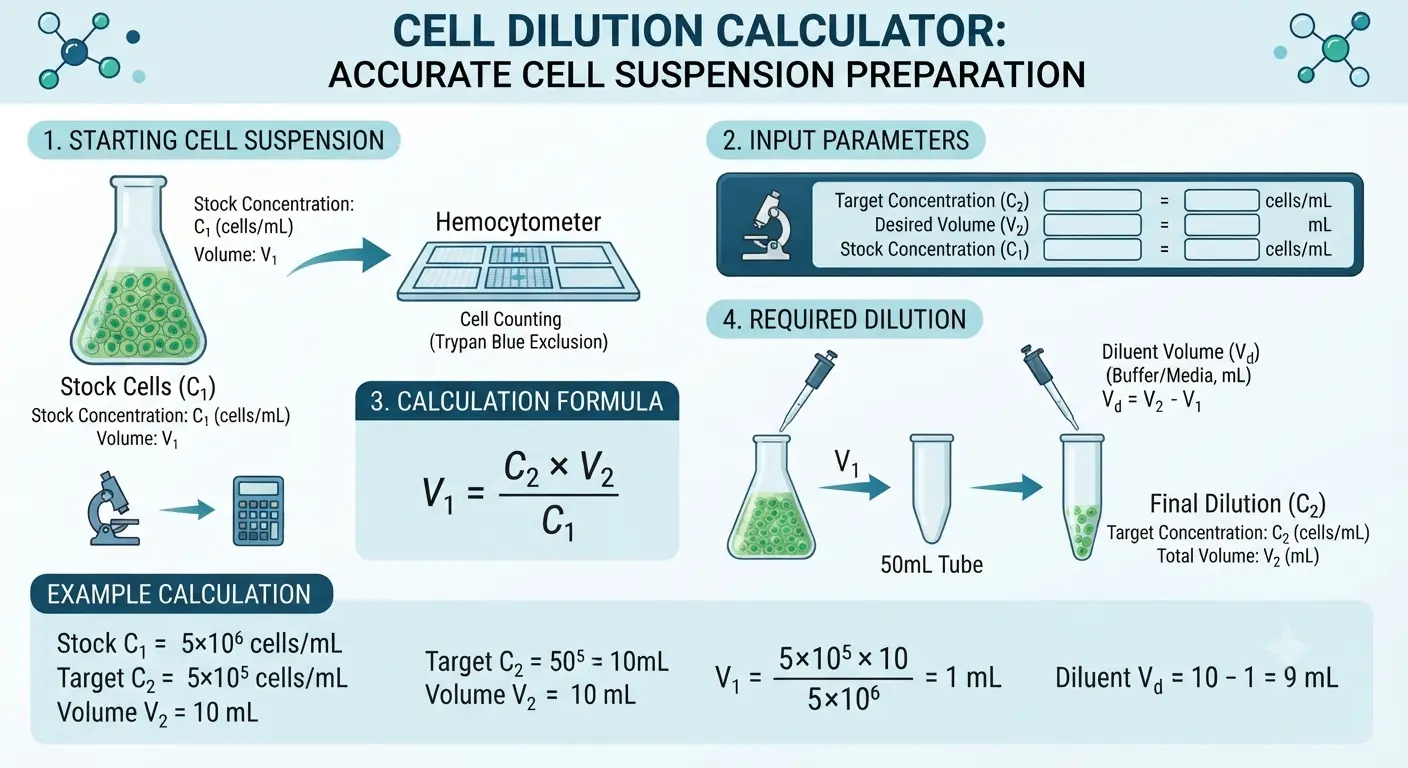
How the Cell Dilution Formula Works
The dilution equation C₁V₁ = C₂V₂ states that the total number of cells before and after dilution is conserved — diluting changes the volume, not the number of cells you already pipetted. By rearranging, the volume of stock you need is V₁ = (C₂ × V₂) / C₁. The diluent volume is then simply V₂ − V₁. This algebra applies to any single-step dilution and is described in standard texts such as Freshney's *Culture of Animal Cells*.
C₁ — concentration of your stock cell suspension (cells/mL), measured with a hemocytometer or automated counter
V₁ — volume of stock you should pipette (the calculator's primary output)
C₂ — desired target concentration after dilution
V₂ — final total volume of the diluted suspension
Diluent volume = V₂ − V₁ — the fresh media or buffer you add to reach the final volume
Dilution factor = C₁ / C₂ — how many times more concentrated the stock is than the target
How to Use This Calculator (Step by Step)
The calculator removes the arithmetic so you can focus on good technique. Follow these steps to prepare any cell dilution accurately:
Count your stock suspension with a hemocytometer or automated counter and enter the value as the Stock Cell Concentration (C₁)
Enter the Target Cell Concentration (C₂) required by your assay or seeding protocol
Enter the Final Total Volume (V₂) you need to prepare — include a 10–20% overage for pipetting losses
Read the Volume of Stock to Add (V₁) — pipette exactly this much stock suspension into your tube
Add the reported Volume of Diluent / Media to reach the final volume, then mix gently and use immediately
Always prepare slightly more than you strictly need (a 10–20% overage). Dead volume in pipettes, reservoirs, and serological tips means the last well is often short if you mix exactly V₂.
Units, Concentrations, and Conversions
The C₁V₁ = C₂V₂ relationship is unit-agnostic — the only rule is that C₁ and C₂ must share the same unit, and V₁ and V₂ must share the same unit. Cell concentrations are usually written in scientific notation, so keep these equivalences handy when entering values.
| Written as | Scientific notation | Plain number (cells/mL) |
|---|---|---|
| 10 thousand | 1 × 10⁴ | 10,000 |
| 100 thousand | 1 × 10⁵ | 100,000 |
| 1 million | 1 × 10⁶ | 1,000,000 |
| 5 million | 5 × 10⁶ | 5,000,000 |
| 10 million | 1 × 10⁷ | 10,000,000 |
| 1 mL | — | 1000 µL |
Enter concentrations as plain numbers (for example 10000000 for 1×10⁷). If your protocol lists cells per well rather than cells/mL, divide the cells-per-well target by the working volume per well to convert it into a cells/mL target first.
Typical Cell Seeding Densities
Use the table below as a starting reference for common mammalian cell seeding densities. Always confirm with your assay protocol and validate by counting.
| Vessel | Surface area | Typical seeding density | Working volume |
|---|---|---|---|
| 96-well plate | 0.32 cm² | 1–5 × 10⁴ cells/well | 100 µL |
| 24-well plate | 2 cm² | 5 × 10⁴ – 2 × 10⁵ cells/well | 500 µL |
| 12-well plate | 4 cm² | 1 × 10⁵ – 4 × 10⁵ cells/well | 1 mL |
| 6-well plate | 10 cm² | 3 × 10⁵ – 1 × 10⁶ cells/well | 2 mL |
| T-25 flask | 25 cm² | 7 × 10⁵ – 2 × 10⁶ cells | 5 mL |
| T-75 flask | 75 cm² | 2 × 10⁶ – 5 × 10⁶ cells | 15 mL |
Single-Step vs Serial Dilution
A single-step dilution works perfectly when the dilution factor is modest (roughly ≤ 20×). When the factor is large, the required stock volume (V₁) becomes so small that pipetting error dominates and your counts become unreliable. In those cases a serial dilution — several smaller dilutions performed in sequence — gives far more reproducible results.
Single-step: best for 1.5× to ~20× dilutions where V₁ is comfortably pipettable (≥ 20 µL)
Serial dilution: for 50× or greater, split into stages such as 1:10 followed by 1:10 to reach 1:100
The total dilution factor of a serial dilution is the product of each step (10 × 10 = 100×)
Mix thoroughly between every step — incomplete mixing is the single biggest source of serial-dilution error
Use a fresh tip for each transfer to avoid carryover that inflates downstream counts
Counting Cells Accurately Before You Dilute
Your dilution is only as good as the stock count it starts from. The variability of hemocytometer counts is typically 10–20%, so the count — not the math — is usually the limiting factor in reproducibility.
- Hemocytometer:
count at least 100 cells across multiple large squares, then average; concentration = (mean count per square) × dilution × 10⁴ cells/mL
- Automated cell counters:
faster and lower variability, but validate against a hemocytometer periodically
- Flow cytometry / Coulter counter:
highest precision for large sample numbers and small particles
Always stain with a viability dye (e.g. trypan blue) and count only live cells if you need viable-cell density
Count in duplicate and average — a single count can be off by 20% or more
Best Practices for Accurate Cell Dilutions
Reproducible results require accurate counts and good pipetting technique. Small volumes amplify error, and cells settle quickly, so technique matters as much as arithmetic.
Resuspend the stock thoroughly — cells settle quickly and skew counts
Use a viability dye (e.g. trypan blue) and count only live cells
Pipette stock volumes ≥ 20 µL when possible — small volumes amplify error
Pre-warm media to 37 °C to avoid temperature shock
If V₁ < 10 µL, perform an intermediate dilution rather than a single step
Mix gently after dilution; vortexing damages many adherent and primary cell types
Work quickly and keep cells at the appropriate temperature to maintain viability
Where Cell Dilutions Are Used
Accurate single-step dilutions underpin a huge range of laboratory workflows. The same C₁V₁ = C₂V₂ math applies whether you are working with mammalian cells, bacteria, or yeast.
Seeding multi-well plates for transfection, drug screening, or cytotoxicity assays
Preparing cells at defined density for flow cytometry or FACS
Standardizing inoculum for bacterial growth curves and OD₆₀₀ measurements
Setting up viability and proliferation assays (MTT, MTS, resazurin)
Diluting cells before counting to bring very dense stocks into the countable range
Preparing input cells for downstream molecular work — pair with our DNA concentration calculator and ligation calculator
Common Mistakes to Avoid
Most failed dilutions come down to a handful of avoidable errors. Watch for these before you commit precious cells:
- Mismatched units:
C₁ and C₂ must be in the same units (both cells/mL), and V₁ and V₂ in the same units (both mL)
- Target higher than stock:
dilution can only reduce concentration — if C₂ > C₁ you must concentrate first
- Pipetting V₁ < 10 µL in a single step:
switch to a serial dilution to keep error low
- Not resuspending before sampling:
settled cells make the stock count too low and the dilution too dense
- Forgetting the overage:
prepare 10–20% extra so the last well is not short
- Counting dead cells:
without a viability dye your effective live-cell density will be lower than calculated
Troubleshooting Cell Dilutions
If your plated density does not match expectations, use this table to find the likely cause and fix it on the next prep.
| Symptom | Likely cause | Fix |
|---|---|---|
| Cells too sparse after seeding | Stock overcounted, or cells settled before sampling | Recount after thorough resuspension; count only viable cells |
| Cells too dense / overgrown | Stock undercounted, or target entered too high | Recount; verify C₂ matches the assay protocol |
| Inconsistent density between wells | Suspension settling during dispensing | Swirl frequently; use a reservoir and multichannel pipette |
| Very small V₁ flagged | Dilution factor too large for a single step | Switch to a serial dilution (e.g. 1:10 then 1:10) |
| Low viability after dilution | Cold media or harsh mixing | Pre-warm media to 37 °C; mix gently, never vortex |
Cell Dilution Glossary
Key terms used in cell dilution and cell culture. Understanding these will help you interpret the calculator's results and your protocols:
| Term | Definition |
|---|---|
| Stock concentration (C₁) | The cell concentration of the undiluted suspension, measured after counting (cells/mL). |
| Target concentration (C₂) | The desired cell concentration after dilution required by your assay or seeding protocol. |
| Dilution factor | How many times the stock is diluted, equal to C₁ ÷ C₂ (e.g. 10× means one part stock to nine parts diluent). |
| Diluent | The fresh medium, buffer, or saline added to reduce the concentration to the target. |
| Hemocytometer | A precision counting chamber with an etched grid used to count cells under a microscope. |
| Viability | The fraction of live cells in a suspension, usually assessed with trypan blue exclusion. |
| Serial dilution | A sequence of stepwise dilutions whose factors multiply together to reach a large total factor. |
| Seeding density | The number of cells (or cells/cm²) plated into a culture vessel at the start of an experiment. |
Quick Reference Card
Cell Dilution — Quick Reference
Quick reference • Cell Dilution Calculator
V₁ = (C₂ × V₂) / C₁ • Diluent = V₂ − V₁ • DF = C₁ / C₂Valid range: Target C₂ ≤ Stock C₁ (dilution only reduces concentration)
Common Values
⚠ Watch Out
- •C₁ and C₂ must share the same units; V₁ and V₂ must share the same units
- •Target concentration can never exceed stock concentration
- •Avoid pipetting V₁ below 10 µL — switch to a serial dilution
- •Count only viable cells, and resuspend thoroughly before sampling
Pro Tips
- →Prepare 10–20% extra volume to cover pipette and reservoir dead volume
- →Pre-warm media to 37 °C to protect viability
- →Mix gently after diluting — vortexing damages adherent and primary cells
- →Count in duplicate and average to cut the 10–20% counting error
FAQs
What if my target concentration is higher than my stock?
Dilution can only reduce concentration. If your target is higher than your stock, you must concentrate the cells first (e.g. by gentle centrifugation and resuspension in a smaller volume) before using the dilution formula. The calculator returns zero values when the target exceeds the stock to flag this physically impossible case.
How do I calculate the volume of cell suspension I need?
Use V₁ = (C₂ × V₂) / C₁, where C₁ is your stock concentration, C₂ is your target concentration, and V₂ is the final volume you want. The diluent (media) you add is V₂ − V₁. This calculator does both steps for you automatically and also reports the dilution factor.
Does this work for OD600 measurements of bacteria or yeast?
Yes — the C₁V₁ = C₂V₂ relationship is unit-agnostic. As long as C₁ and C₂ are expressed in the same units (cells/mL, OD₆₀₀, CFU/mL, etc.), the calculator returns valid volumes. It is widely used to standardize bacterial inoculum for growth curves.
Why is the calculated stock volume so small?
When the dilution factor is very large (e.g. > 100×), the required stock volume becomes very small and pipetting error dominates. The recommended workaround is a serial dilution: dilute 1:10 first, then 1:10 again to achieve 1:100, instead of attempting a single-step 1:100 dilution. Aim to keep V₁ at or above 20 µL per step.
What is a dilution factor and how do I read it?
The dilution factor is C₁ ÷ C₂ — it tells you how many times more concentrated the stock is than the target. A 10× dilution factor means one part stock plus nine parts diluent. The calculator displays the dilution factor alongside the stock and diluent volumes.
What diluent should I use?
For mammalian cells, use the same complete growth medium (with serum) you culture them in. For bacterial / yeast suspensions intended for plating or OD measurement, use sterile PBS, saline, or fresh medium depending on the downstream assay. Always pre-warm mammalian media to 37 °C.
Should I count cells before or after diluting?
Always count the stock before diluting, because the calculator needs the stock concentration (C₁) as an input. If the stock is extremely dense and hard to count, perform a known intermediate dilution, count that, then multiply back up to get the true stock concentration.
How much extra suspension should I prepare?
Prepare 10–20% more than the strict total your wells require. Dead volume in pipette tips, reservoirs, and serological pipettes means the final well is often short if you mix exactly the volume you need. Enter the padded volume as your final volume (V₂).