Last updated: June 20, 2026
Ligation Calculator

Creators
Dharmendra SinghReviewers
Creators
Dharmendra SinghReviewers
Quick Answer
The Ligation Calculator determines how much insert DNA to add to a cloning ligation for a target insert:vector molar ratio. The core formula is insert mass (ng) = molar ratio × vector mass (ng) × insert length (bp) ÷ vector length (bp); the length term corrects for the fact that longer fragments weigh more per molecule. Molar amounts use fmol = mass (ng) × 1,000,000 ÷ (length in bp × 650), where 650 Da is the average weight of one base pair of dsDNA, so the insert fmol equals the ratio times the vector fmol. With 50 ng of a 5,000 bp vector and a 1,000 bp insert at 3:1, you add 30 ng of insert. Recommended ratios are 3:1 for sticky ends, up to 5:1 for blunt ends, and 1:1 to 2:1 for inserts larger than the vector. If you supply the insert stock concentration, the tool also returns the pipetting volume.
To set up a DNA ligation, multiply your desired molar ratio by the vector mass and by the insert length divided by the vector length. For a three to one ratio with fifty nanograms of a five thousand base pair vector and a one thousand base pair insert, you add thirty nanograms of insert.
Key Takeaways
- Insert (ng) = ratio × vector (ng) × insert length ÷ vector length — balance molecules, not mass
- fmol = ng × 10⁶ ÷ (bp × 650); by design insert fmol = ratio × vector fmol
- Use 3:1 for sticky ends, up to 5:1 for blunt, and 1:1–2:1 for large inserts
- Keep vector at 50–100 ng to limit self-ligation background
- Always run a vector-only (no insert) control to measure background
Creators
Dharmendra SinghReviewers
Creators
Dharmendra SinghReviewers
Formula
Insert (ng) = Ratio × Vector (ng) × Insert length (bp) / Vector length (bp)
Where:
- ng_{insert}=Mass of insert DNA to add(ng)
- ng_{vector}=Mass of vector DNA in the reaction(ng)
- R=Desired insert : vector molar ratio (typically 3)
- bp=Fragment length in base pairs(bp)
Worked Examples
Standard 3:1 sticky-end ligation
50 ng of a 5,000 bp vector, a 1,000 bp insert, at the classic 3:1 ratio.
- 1Insert = 3 × 50 ng × (1,000 ÷ 5,000) = 3 × 50 × 0.2 = 30 ng
- 2Vector = 50 ng of 5,000 bp ≈ 15.4 fmol
- 3Insert = 30 ng of 1,000 bp ≈ 46.2 fmol (= 3 × vector, as intended)
- 4At 20 ng/µL, pipette 30 ÷ 20 = 1.5 µL of insert
1:1 ratio for a large insert
100 ng of a 3,000 bp vector and a 3,000 bp insert at 1:1.
- 1Insert = 1 × 100 ng × (3,000 ÷ 3,000) = 100 ng
- 2Equal lengths at 1:1 → equal masses
- 3Vector ≈ 51.3 fmol · Insert ≈ 51.3 fmol
- 4Large inserts often ligate best near a 1:1–2:1 ratio
5:1 ratio for a blunt-end ligation
Blunt ends are inefficient, so use more insert: 50 ng of a 6,000 bp vector, 500 bp insert.
- 1Insert = 5 × 50 ng × (500 ÷ 6,000) ≈ 20.83 ng
- 2Small insert relative to vector → modest mass even at 5:1
- 3Vector ≈ 12.8 fmol · Insert ≈ 64.1 fmol (5×)
- 4Blunt ligations also benefit from more ligase and longer incubation
Small insert into a large vector, with volume
75 ng of a 7,000 bp vector, a 700 bp insert at 3:1, insert at 10 ng/µL.
- 1Insert = 3 × 75 ng × (700 ÷ 7,000) = 22.5 ng
- 2At 10 ng/µL, pipette 22.5 ÷ 10 = 2.25 µL
- 3Vector ≈ 16.5 fmol · Insert ≈ 49.5 fmol
- 4Keep total DNA reasonable so the ligase buffer/PEG isn't diluted
Introduction
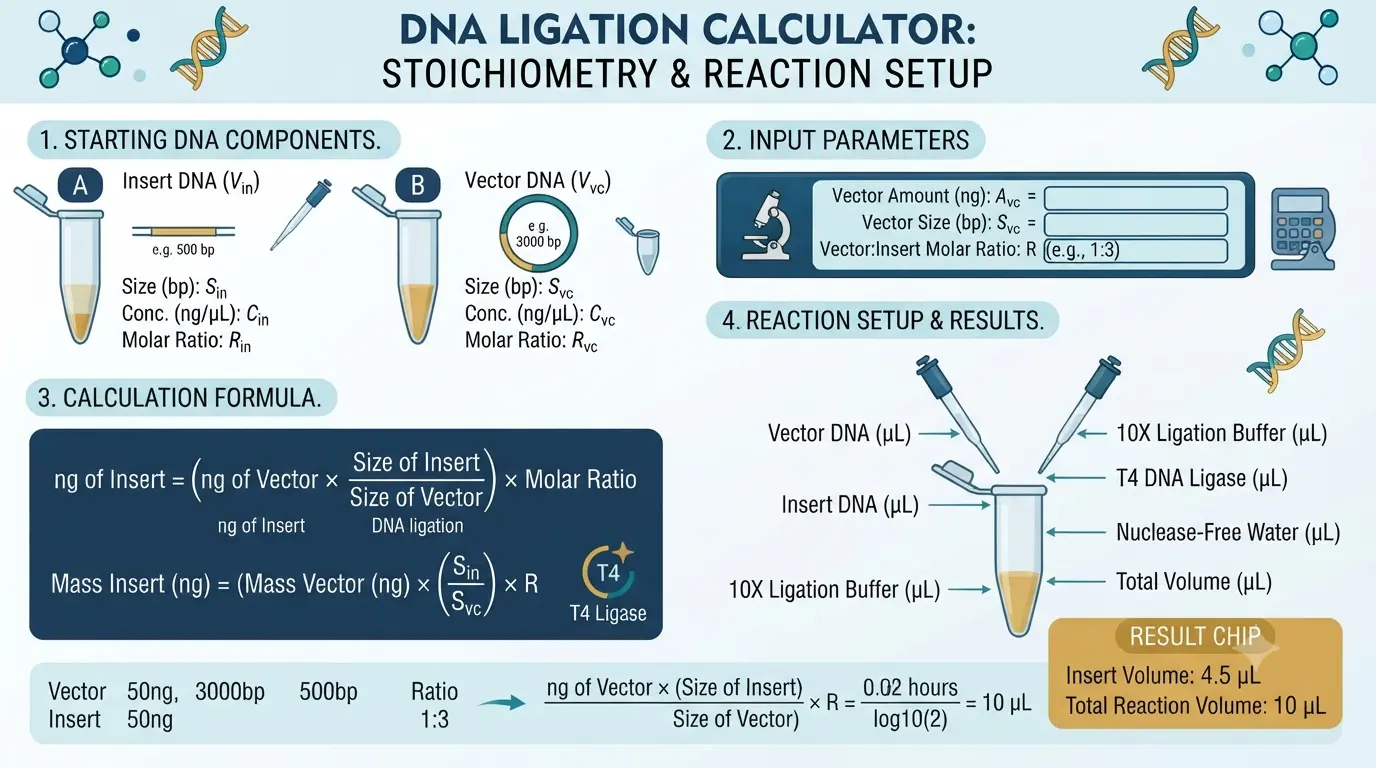
The Ligation Calculator tells you exactly how much insert DNA to add to a cloning ligation so that the insert : vector molar ratio is right — the single biggest factor in getting colonies on your plate. Because longer fragments weigh more per molecule, you can't just mix equal masses: a correct ligation balances the *number of molecules*, not the nanograms. Enter your vector mass and length, the insert length, and a target molar ratio (3:1 is the usual starting point), and the calculator returns the insert mass to add, the molar amounts (fmol) of each fragment, and — if you give the insert's concentration — the volume to pipette. It pairs naturally with our DNA Concentration Calculator for quantifying your stocks and the Annealing Temperature Calculator for the PCR that generates your insert.
How the Calculation Works
Ligation efficiency depends on the ratio of insert molecules to vector molecules, not on mass. The calculator converts between mass and moles using the average molecular weight of double-stranded DNA.
Insert mass = ratio × vector mass × (insert length ÷ vector length).
The length ratio corrects for the fact that a longer fragment has more mass per molecule.
Molar amount is computed as fmol = ng × 10⁶ / (bp × 650), where 650 Da is the average mass of one base pair of dsDNA.
By design, insert fmol = ratio × vector fmol — that's the whole point of the molar ratio.
If you enter the insert's stock concentration, volume = insert mass ÷ concentration gives the µL to add.
Keep the vector amount modest (50–100 ng). Adding far more vector wastes prep and increases empty-vector background from self-ligation.
How to Use This Calculator (Step by Step)
You need the masses and lengths of your two fragments and a target ratio. Quantify your DNA first (NanoDrop, Qubit or gel).
Enter the vector mass (typically 50–100 ng) and its length in bp.
Enter the insert length in bp.
Choose a molar ratio — 3:1 for standard sticky ends, more for blunt or difficult ligations.
Optionally add the insert concentration to get the exact volume to pipette.
Read the insert mass, fmol amounts, and volume, then set up your reaction.
Choosing the Right Molar Ratio
The optimal insert:vector ratio depends on the ends and the fragment sizes. When a cloning fails, re-running with a different ratio is one of the first things to try.
| Situation | Suggested ratio (insert:vector) | Why |
|---|---|---|
| Standard sticky/cohesive ends | 3:1 | Reliable default; favours insert uptake over self-ligation |
| Blunt ends | 5:1 (up to 10:1) | Blunt ligation is inefficient, so push more insert |
| Large insert (> vector) | 1:1 – 2:1 | Excess of a big fragment promotes concatemers and tangles |
| Small insert (≪ vector) | 3:1 – 7:1 | More molecules needed to find the vector ends |
| Multiple-fragment (Gibson/Golden Gate) | 2:1 per insert | Each junction needs balanced molar amounts |
A ratio that is too high promotes insert concatemers (multiple inserts) and multimeric products; too low favours empty re-ligated vector. 3:1 is a robust starting point for most two-piece clones — you can cross-check any setup with the NEBioCalculator ligation tool.
Setting Up the Ligation Reaction
A typical T4 DNA ligase reaction is small (10–20 µL). Keep the DNA concentrated enough to find each other but not so much that the buffer is diluted.
Combine vector, insert, 10× T4 ligase buffer (contains ATP), T4 DNA ligase and water to volume.
Use fresh buffer — the ATP degrades through freeze-thaw cycles and old buffer is a common failure cause.
Sticky ends: 10 min–1 h at room temperature, or 16 °C overnight for tricky cases.
Blunt ends: add PEG (or use a blunt/quick ligase kit), more enzyme, and longer incubation.
Heat-inactivate or purify before electroporation; chemical transformation can usually take the reaction directly.
Essential Controls
Two simple controls turn a failed cloning into useful information about what went wrong.
Vector-only (no insert) control: colonies here mean your vector is re-ligating — improve dephosphorylation or digestion.
Vector + ligase, no insert vs vector, no ligase: separates self-ligation from uncut/undigested vector.
A good experiment shows many more colonies on the insert plate than the vector-only control.
Include a transformation-efficiency control (known plasmid) to confirm your competent cells work.
Always run an uncut and cut vector on a gel to confirm complete digestion before ligating.
Troubleshooting Low or No Colonies
If a ligation yields few or no correct clones, work through the usual suspects systematically.
- **No colonies at all:
** check competent-cell efficiency, antibiotic, and that the ligase buffer's ATP is fresh.
- **Only empty vector:
** improve vector digestion/dephosphorylation, or raise the insert:vector ratio.
- **Insert concatemers:
** lower the ratio toward 1:1–2:1 and reduce total DNA.
- **Wrong-size inserts:
** verify fragment sizes on a gel and re-quantify before recalculating.
- **Inconsistent results:
** standardise on a Qubit/fluorometric quantification rather than A260, which over-reads.
Glossary
Key terms used in DNA ligation and cloning:
| Term | Definition |
|---|---|
| Vector | The plasmid backbone that carries the insert and replicates in the host. |
| Insert | The DNA fragment of interest being cloned into the vector. |
| Molar ratio | The ratio of insert molecules to vector molecules (not masses) in the reaction. |
| Sticky / cohesive ends | Single-stranded overhangs left by many restriction enzymes that base-pair to join fragments. |
| Blunt ends | Flush double-stranded ends with no overhang; ligate less efficiently. |
| T4 DNA ligase | The enzyme that forms phosphodiester bonds to join DNA ends, using ATP. |
| fmol | Femtomole (10⁻¹⁵ mol) — the practical unit for molar amounts of DNA fragments. |
| Dephosphorylation | Removing 5′ phosphates from the vector to prevent it self-ligating. |
Quick Reference Card
Ligation — Quick Reference
Quick reference • Ligation Calculator
Insert(ng) = R × Vector(ng) × insert_bp ÷ vector_bp · fmol = ng × 10⁶ ÷ (bp × 650)Valid range: Vector typically 50–100 ng; ratio 1:1 to 10:1; reaction 10–20 µL.
Common Values
⚠ Watch Out
- •Balance moles (fmol), not nanograms
- •Use fresh ligase buffer — ATP degrades on freeze-thaw
- •Too-high ratios cause insert concatemers; too-low favours empty vector
- •Run a vector-only control to measure self-ligation background
Pro Tips
- →Quantify DNA by Qubit/fluorometry, not A260, for accuracy
- →Dephosphorylate vector with compatible ends to cut background
- →Use 16 °C overnight for difficult or blunt ligations
- →Keep total DNA modest so PEG/buffer isn't diluted
FAQs
How do I calculate how much insert to use in a ligation?
Use insert mass (ng) = molar ratio × vector mass (ng) × insert length (bp) ÷ vector length (bp). For example, for a 3:1 ratio with 50 ng of a 5,000 bp vector and a 1,000 bp insert, you need 3 × 50 × (1,000 ÷ 5,000) = 30 ng of insert. The calculator does this automatically and also gives the molar amounts in fmol and the pipetting volume if you provide the insert concentration.
Why is the ratio based on moles, not mass?
Ligation depends on how many molecules of insert and vector meet end-to-end, which is a molar quantity. Because a longer fragment weighs more per molecule, equal masses of a long vector and a short insert contain very different numbers of molecules. The length term in the formula corrects for this so that a '3:1 ratio' really means three insert molecules per vector molecule.
What insert:vector ratio should I use?
A 3:1 insert-to-vector molar ratio is the standard starting point for sticky-end ligations. Use up to 5:1 (or even 10:1) for inefficient blunt-end ligations, and drop toward 1:1–2:1 when the insert is larger than the vector to avoid concatemers. If a cloning fails, trying a different ratio is one of the quickest things to change.
How do you convert nanograms of DNA to fmol?
Use fmol = mass (ng) × 10⁶ ÷ (length in bp × 650), where 650 daltons is the average molecular weight of one base pair of double-stranded DNA. For instance, 50 ng of a 5,000 bp fragment is about 15.4 fmol. Working in fmol lets you compare insert and vector by molecule count rather than weight.
How much vector should I put in a ligation?
Typically 50–100 ng of vector in a 10–20 µL reaction. Using much more wastes purified vector and tends to raise background from vector self-ligation, while too little can drop below the concentration where ends find each other efficiently. Set the vector amount first, then let the calculator scale the insert to your chosen ratio.
Why am I only getting empty-vector colonies?
Empty (self-ligated) vector usually means incomplete digestion or insufficient dephosphorylation, or too little insert. Make sure the vector is fully cut (check on a gel), dephosphorylate it if you used a single enzyme or compatible ends, and raise the insert:vector ratio. The vector-only control tells you how much background self-ligation you have.
Does this calculator work for Gibson Assembly or Golden Gate?
It calculates classic two-fragment ligation amounts, which also make a good starting point for assembly methods. For multi-fragment Gibson or Golden Gate reactions, aim for roughly balanced molar amounts of each piece (often about 2:1 insert:vector per junction) and consult your kit's protocol for the recommended total fmol per fragment.