Last updated: May 24, 2026
Cat Benadryl Dosage Calculator

Creators
Dharmendra SinghReviewers
Creators
Dharmendra SinghReviewers
Quick Answer
Benadryl (diphenhydramine) for cats is dosed at 1 mg per pound of body weight (≈ 2.2 mg/kg) using Dose (mg) = Weight (lb) × 1, given every 8–12 hours, with a maximum of 25 mg per single dose. A 10 lb cat receives 10 mg, which is 4 mL of children's liquid Benadryl (12.5 mg/5 mL) or about 0.4 of a 25 mg tablet. Use only plain diphenhydramine with no decongestants, acetaminophen, xylitol, or alcohol, and confirm the dose with your veterinarian.
To dose Benadryl for a cat, give one milligram of diphenhydramine per pound of body weight, every eight to twelve hours, but never more than twenty-five milligrams per dose; a ten pound cat gets ten milligrams, which is four millilitres of children's liquid Benadryl.
Key Takeaways
- Cat Benadryl dose: 1 mg diphenhydramine per pound (≈ 2.2 mg/kg), every 8–12 hours.
- Never exceed 25 mg per single dose for any cat.
- A 10 lb cat gets 10 mg = 4 mL of children's liquid (12.5 mg/5 mL) or ≈ 0.4 of a 25 mg tablet.
- Use ONLY plain diphenhydramine — combination cold/flu products are toxic.
- Confirm the dose with your vet first, especially for kittens or cats with chronic conditions.
Creators
Dharmendra SinghReviewers
Creators
Dharmendra SinghReviewers
Formula
Dose (mg) = Cat Weight (lbs) × 1 mg/lb
Where:
- D_mg=Diphenhydramine dose(mg)
- W_lbs=Cat body weight(lbs)
Worked Examples
8 lb Cat
- 1Dose = 8 lbs × 1 mg/lb = 8 mg
- 2Liquid = 8 mg ÷ 2.5 mg/mL = 3.2 mL
- 3Tablets (25mg) = 8 ÷ 25 = 0.32 tablets
4 kg Cat
- 1Convert: 4 kg × 2.205 = 8.82 lbs
- 2Dose = 8.82 mg
- 3Liquid = 8.82 ÷ 2.5 = 3.5 mL
Introduction
The Cat Benadryl Dosage Calculator determines a safe diphenhydramine dose for cats based on body weight. The standard veterinary dose is 1 mg per pound (≈ 2.2 mg/kg) of body weight, given every 8–12 hours, and no more than 25 mg per single dose. Enter your cat's weight and the calculator returns the milligram dose plus the practical amount — millilitres of children's liquid Benadryl (12.5 mg / 5 mL) or fraction of a 25 mg tablet. Because cats metabolize drugs differently than dogs, dosing must be precise and use only plain diphenhydramine. For related tools, see our cat age calculator, cat BMI calculator, and the companion Benadryl dosage calculator for dogs.
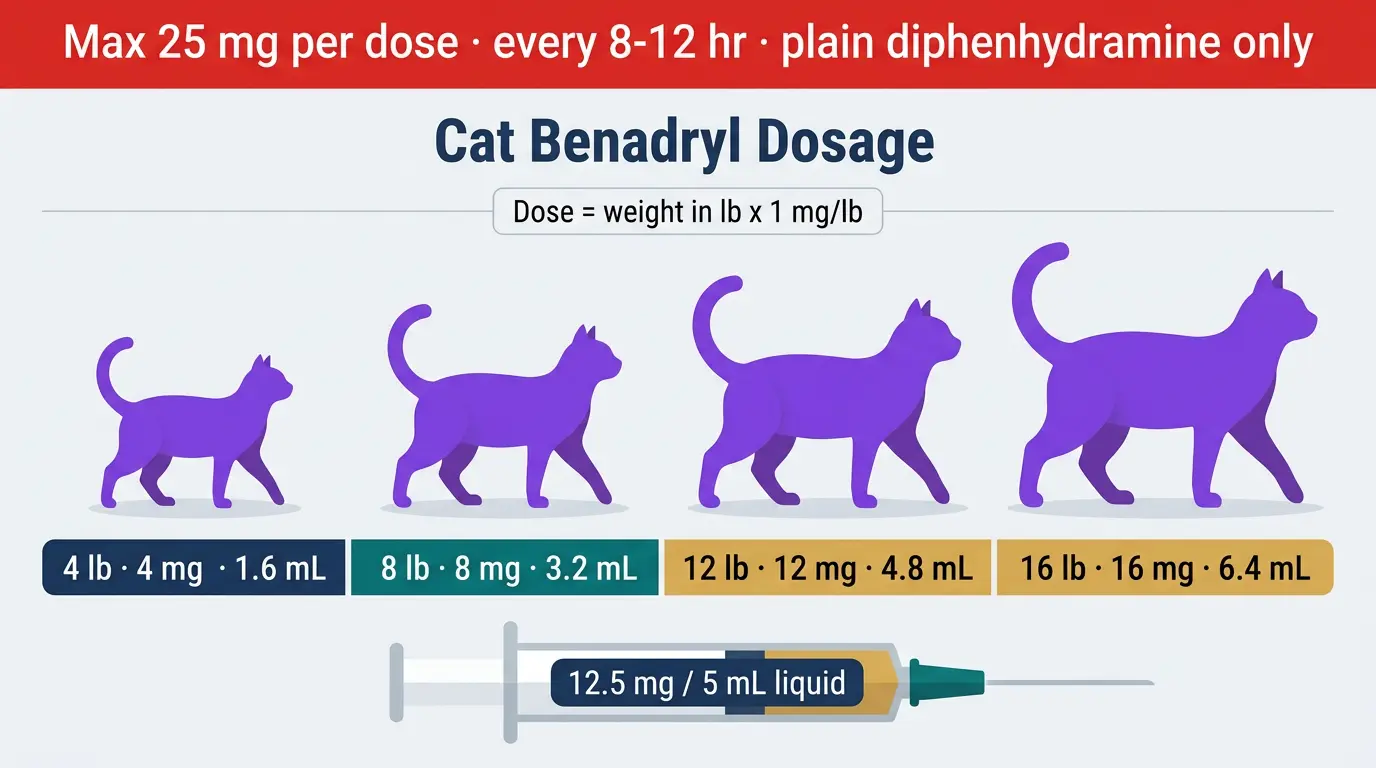
How Cat Benadryl Dosing Works
The dose math is the same as for dogs — 1 mg per pound (or ~2.2 mg/kg) — but cats are smaller and more sensitive to medications, so accuracy matters more. The calculator converts mg into the practical amount for the formulation you have: millilitres of children's liquid Benadryl or a fraction of a 25 mg tablet. Because most cats need under 12 mg per dose, liquid is usually the easier and more accurate option.
- Standard dose:
1 mg diphenhydramine per 1 lb of body weight (≈ 2.2 mg/kg)
- Frequency:
every 8–12 hours (2–3 times daily) as needed
- Maximum single dose:
25 mg — never exceed this for cats
Children's liquid (12.5 mg/5 mL) — mL = dose (mg) ÷ 2.5
Adult tablets are 25 mg — most cats need a quarter to half tablet
- Onset:
~30 minutes · duration: 8–12 hours
Round down rather than up. A 10.5 lb cat is fine on a 10 mg dose; pushing to 11 mg gains nothing and risks side effects.
Cat Benadryl Dosage Chart by Weight
Use this reference chart for quick dosage lookup. All doses are based on the standard 1 mg/lb veterinary guideline. Liquid concentration is children's Benadryl, 12.5 mg / 5 mL.
| Cat Weight (lbs) | Cat Weight (kg) | Dose (mg) | Liquid 12.5 mg / 5 mL | 25 mg Tablets |
|---|---|---|---|---|
| 4 lb | 1.8 kg | 4 mg | 1.6 mL | ≈ ⅙ tab |
| 6 lb | 2.7 kg | 6 mg | 2.4 mL | ≈ ¼ tab |
| 8 lb | 3.6 kg | 8 mg | 3.2 mL | ≈ ⅓ tab |
| 10 lb | 4.5 kg | 10 mg | 4.0 mL | ≈ ⅖ tab |
| 12 lb | 5.4 kg | 12 mg | 4.8 mL | ≈ ½ tab |
| 14 lb | 6.4 kg | 14 mg | 5.6 mL | ≈ ½–⅗ tab |
| 16 lb | 7.3 kg | 16 mg | 6.4 mL | ≈ ⅗ tab |
| 18 lb | 8.2 kg | 18 mg | 7.2 mL | ≈ ¾ tab |
| 20 lb | 9.1 kg | 20 mg | 8.0 mL | ≈ ⅘ tab |
Splitting tablets into accurate fractions is difficult — for most cats, the liquid form delivers a much more precise dose.
How to Give Your Cat Benadryl
Getting an antihistamine into a cat is often the hardest part. The liquid form, drawn into an oral dosing syringe and aimed into the side of the mouth, is usually the most reliable. Tablets can be hidden in a small piece of tuna, wet food, or a flavored pill pocket.
Draw the mL from a children's liquid bottle (12.5 mg/5 mL) into a 1 mL or 3 mL syringe
Aim the syringe into the side cheek pouch, not the back of the throat
Give a tiny treat or rinse with water afterward to clear the taste
Crush quarter-tablets into wet food only if your cat accepts it
Wait 30 minutes before re-dosing if your cat spat the first dose
Pre-measure several doses in syringes ahead of bee-sting season — that way you can dose immediately when minutes matter.
When to Use Benadryl for Cats
Benadryl is one of the few over-the-counter human medications considered relatively safe for cats when dosed correctly. It is a first-generation H1 antihistamine that blocks histamine receptors to reduce allergic symptoms.
- Mild allergic reactions:
insect bites, bee stings, contact allergies
- Vaccine reactions:
mild hypersensitivity post-vaccination (vet-directed)
- Motion sickness:
helps during car or plane travel
- Mild situational anxiety:
short trips or vet visits
- Environmental allergies:
seasonal itching, watery eyes, sneezing
Facial swelling, difficulty breathing, or collapse after a sting or new food can mean anaphylaxis — go directly to an emergency vet rather than waiting for Benadryl to work.
Safety Warnings and Contraindications
Benadryl is generally safe for healthy adult cats, but several conditions and product types make it dangerous. Use only plain diphenhydramine HCl as the sole active ingredient.
Never use combination cold/flu/sinus products (decongestants are toxic)
Avoid any liquid containing xylitol or alcohol
Glaucoma — diphenhydramine raises intraocular pressure
Hyperthyroidism, heart disease, or seizure disorders — vet approval required
Pregnant or nursing queens — safety not established
Kittens under 6 months, or cats under 2 lb — vet guidance only
Read the active-ingredient panel aloud: if you see anything other than "diphenhydramine HCl," do not give it to your cat.
Signs of a Benadryl Overdose in Cats
Cats are especially sensitive to diphenhydramine and can flip between extreme sedation and dangerous over-stimulation. If you suspect an overdose, contact your veterinarian or the ASPCA Animal Poison Control Center (888-426-4435) immediately.
Hyperexcitability, agitation, or restlessness
Rapid heart rate (tachycardia) and dilated pupils
Tremors, disorientation, or seizures
Extreme drowsiness or trouble walking
Dry mouth, constipation, or urinary retention
Rapid or laboured breathing
Bring the product packaging to the vet so the team can calculate exactly how much diphenhydramine was ingested.
Why Cats Need Different Dosing Than Dogs
Cats and dogs have the same mg-per-pound dose for Benadryl, but the similarities end there. Cats lack key liver enzymes (notably glucuronyl transferase) that humans and dogs use to clear many drugs, so they are far more sensitive to medication errors, combination products, and many "pet-safe" assumptions.
Cats clear many drugs more slowly than dogs
Single-dose cap is lower for cats (25 mg max)
Xylitol — safe for cats in tiny amounts but absolutely toxic to dogs (avoid in both)
Acetaminophen (Tylenol) — extremely toxic to cats even in tiny doses
Always dose by the cat's weight, never by a human or dog reference
Never substitute a dog medication for a cat — always confirm the species-specific dose and formulation.
Common Cat Benadryl Mistakes to Avoid
Most Benadryl problems in cats come from a handful of avoidable errors rather than the antihistamine itself.
Grabbing a combination cold medicine instead of plain diphenhydramine
Using a liquid that contains xylitol or alcohol
Confusing milligrams (dose) with millilitres (volume)
Re-dosing too soon (less than 8 hours apart)
Splitting a 25 mg tablet by eye instead of by milligrams
Using "Benadryl" branded products that actually contain cetirizine, not diphenhydramine
Some newer products sold under the Benadryl brand contain cetirizine, not diphenhydramine — always dose by the active ingredient, not the brand name.
Quick Reference Card
Cat Benadryl Dosage — Quick Reference
Quick reference • Cat Benadryl Dosage Calculator
Dose (mg) = Weight (lb) × 1 mg/lb · max 25 mg per dose · every 8–12 hrValid range: Cats 0.5–30 lb; standard rate 1 mg/lb (2.2 mg/kg)
Common Values
⚠ Watch Out
- •Use ONLY plain diphenhydramine — combination cold/flu products are toxic
- •Avoid liquids with xylitol or alcohol; never use Benadryl-D
- •Get vet approval for cats with glaucoma, heart, thyroid, or seizure conditions
- •Facial swelling or breathing trouble — go to an emergency vet, don't wait
Pro Tips
- →Children's liquid (12.5 mg/5 mL) gives the most precise feline dose
- →Use a 1 mL or 3 mL oral syringe aimed into the cheek pouch
- →Pre-draw doses in syringes before bee-sting season for quick action
- →Double-check the label lists diphenhydramine HCl as the ONLY active ingredient
FAQs
Can I give my cat Benadryl?
Yes, plain diphenhydramine (Benadryl) is generally safe for cats at 1 mg per pound of body weight, every 8–12 hours, with a maximum of 25 mg per single dose. Always consult your veterinarian first, especially for cats with any health condition.
How much Benadryl can I give a 10 lb cat?
A 10 lb cat can receive 10 mg of diphenhydramine. That equals 4 mL of children's liquid Benadryl (12.5 mg/5 mL), or about 0.4 of a 25 mg adult tablet. Confirm the dose with your vet before the first use.
How often can I give my cat Benadryl?
Benadryl can be given every 8–12 hours, up to about three times daily. Do not exceed 25 mg per single dose for any cat, and do not double up if a dose is missed.
What type of Benadryl is safe for cats?
Use plain diphenhydramine only — children's liquid Benadryl (12.5 mg/5 mL) is usually easiest to dose. Avoid any formula containing xylitol, alcohol, decongestants (pseudoephedrine, phenylephrine), or other active ingredients.
How long does Benadryl take to work in cats?
Diphenhydramine usually starts working within 30 minutes, with peak effects around 1–2 hours, and lasts roughly 8–12 hours. If your cat has a serious allergic reaction (facial swelling, trouble breathing), don't wait — go to an emergency vet.
What are the side effects of Benadryl in cats?
Common side effects include drowsiness, dry mouth, decreased appetite, and urinary retention. About one in twenty cats becomes hyperactive instead of sleepy. Rare serious side effects include rapid breathing, tremors, and seizures.
Can I give my cat Benadryl for anxiety or travel?
Benadryl's mild sedative effect can take the edge off short trips or vet visits for some cats, but it isn't a reliable sedative — some cats become more agitated. Test the response at home before relying on it for travel.
Can kittens take Benadryl?
Kittens under 6 months should only receive Benadryl under direct veterinary guidance, because their organs are still developing and dosing must be very precise. For very small kittens, a vet may use the liquid form so tiny doses can be measured accurately.
What should I do if my cat had too much Benadryl?
Watch for agitation, rapid heart rate, dilated pupils, tremors, or extreme drowsiness, and contact your vet or the ASPCA Animal Poison Control Center (888-426-4435) immediately. Bring the product packaging so the team can calculate how much was ingested.
Can I give my cat Benadryl with other medications?
Benadryl interacts with several drugs, including other sedatives, certain heart and blood-pressure medications, and MAO inhibitors. Always tell your veterinarian what your cat is taking before adding Benadryl, and never combine it with another antihistamine unless specifically directed.
Is Benadryl the same dose for cats and dogs?
The mg-per-pound rate (1 mg/lb) is the same, but cats need much more caution: smaller maximum single dose (25 mg), a slower drug-clearing metabolism, and zero tolerance for combination products with acetaminophen or decongestants.