Last updated: May 24, 2026
Cat Age Calculator

Creators
Dharmendra SinghReviewers
Creators
Dharmendra SinghReviewers
Quick Answer
A cat's age in human years uses the veterinary piecewise formula: if catAge < 6, human age = catAge × 19/3 + 1; if catAge ≥ 6, human age = (catAge − 6) × 4 + 40. So a 1-year-old cat ≈ 7.3, a 3-year-old ≈ 20, and a 10-year-old ≈ 56 human years. Indoor cats typically live 12–18 years (64–88 human-equivalent) while outdoor cats average 2–5 years.
A cat's age in human years follows a piecewise formula: under six, multiply the cat age by nineteen thirds and add one; six or older, subtract six, multiply by four, and add forty. So a ten-year-old cat is about fifty-six in human years.
Key Takeaways
- Cats mature fast: a 1-year-old cat ≈ 15 human years; a 2-year-old ≈ 24.
- After age 6, each cat year adds about 4 human years.
- Formula: catAge < 6 → catAge × 19/3 + 1; catAge ≥ 6 → (catAge − 6) × 4 + 40.
- A 10-year-old cat ≈ 56 human years; cats are 'senior' at 11.
- Indoor cats live 12–18 years on average vs 2–5 for outdoor cats.
Creators
Dharmendra SinghReviewers
Creators
Dharmendra SinghReviewers
Formula
If cat ≥ 6 years: Human Age = (Cat Age − 6) × 4 + 40; If cat < 6 years: Human Age = Cat Age × 19/3 + 1
Where:
- A_human=Equivalent human age(years)
- A_cat=Cat's actual age(years)
Worked Examples
3-Year-Old Cat
A young adult cat at 3 years old.
- 1Cat age = 3 years (< 6, use formula 2)
- 2Human age = 3 × 19/3 + 1 = 19 + 1 = 20 years
10-Year-Old Cat
A mature indoor cat at 10 years old.
- 1Cat age = 10 years (≥ 6, use formula 1)
- 2Human age = (10 − 6) × 4 + 40 = 16 + 40 = 56 years
1-Year-Old Kitten
A kitten that just turned 1 year old.
- 1Cat age = 1 year (< 6, use formula 2)
- 2Human age = 1 × 19/3 + 1 ≈ 7.3 years
Introduction
The Cat Age Calculator converts your cat's actual age into human-equivalent years using a scientifically-derived piecewise formula. Unlike the outdated "7 years per cat year" myth, this model accounts for the fact that cats mature rapidly in their first few years, then age more slowly afterward. It's a common misconception that one year in a cat's life is equivalent to seven human years. In reality, the cat years calculation is a bit more complicated — kittens grow fast while they're still young, but the older they are, the slower the aging process becomes. For other pet aging tools, see our dog age calculator and bird age calculator.
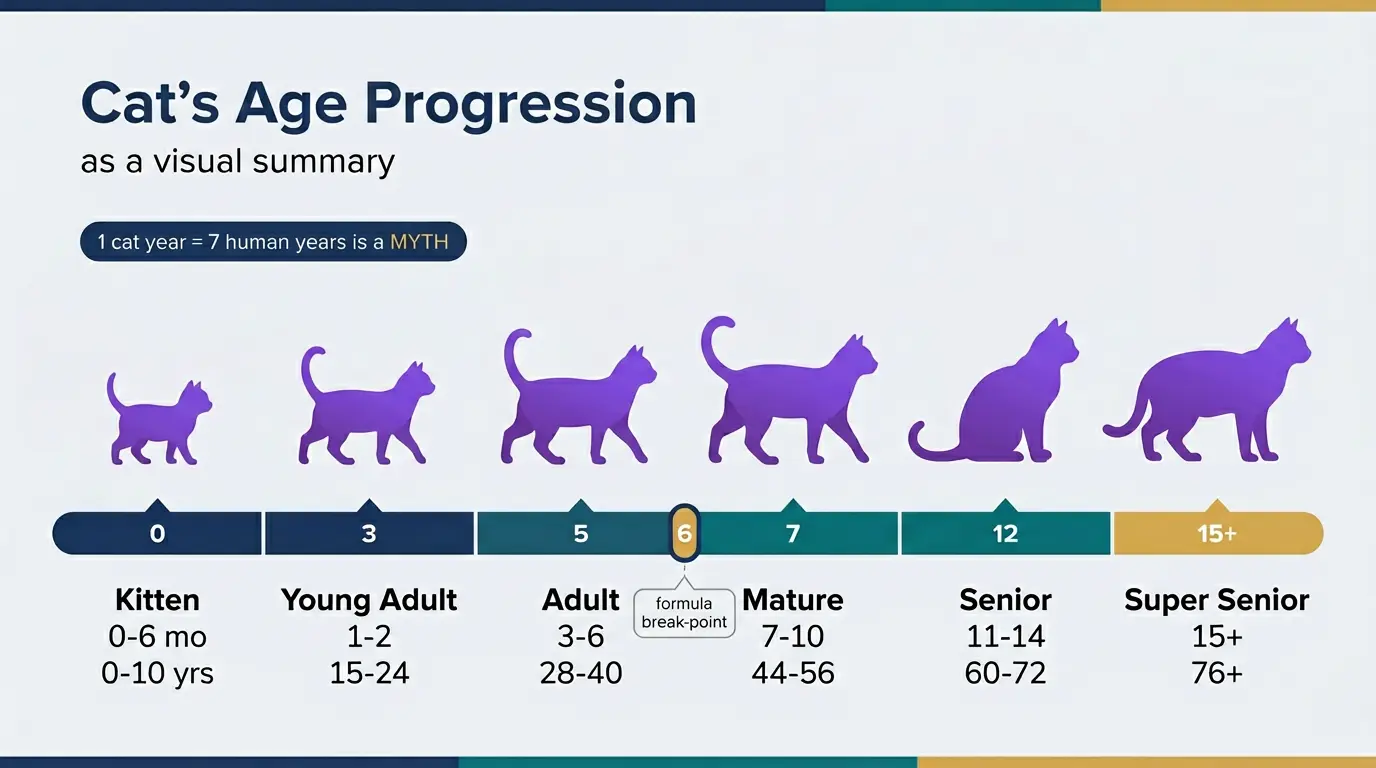
Convert Cat Years to Human Years with the Cat Year Chart
The easiest way to convert between cat years and human years is to use this cat age calculator. Alternatively, you can look at the cat years chart below, which sums up the aging process of a typical feline. This table is based on guidelines from the American Association of Feline Practitioners and International Cat Care.
| Cat Years | Human Years | Life Stage |
|---|---|---|
| 1 | 15 | Young Adult |
| 2 | 24 | Young Adult |
| 3 | 28 | Adult |
| 4 | 32 | Adult |
| 5 | 36 | Adult |
| 6 | 40 | Adult |
| 7 | 44 | Mature Adult |
| 8 | 48 | Mature Adult |
| 9 | 52 | Mature Adult |
| 10 | 56 | Mature Adult |
| 11 | 60 | Senior |
| 12 | 64 | Senior |
| 13 | 68 | Senior |
| 14 | 72 | Senior |
| 15 | 76 | Super Senior |
| 16 | 80 | Super Senior |
| 17 | 84 | Super Senior |
| 18 | 88 | Super Senior |
| 19 | 92 | Super Senior |
| 20 | 96 | Super Senior |
Cat Years Calculator Principles
It's a common misconception that one year in a cat's life is equivalent to seven human years. In reality, the cat years calculation is a bit more complicated. Kittens grow fast while they're still young, but the older they are, the slower the aging process becomes. It means that your cat is as old as a fifteen-year-old human child after one year, but for older cats, each year is equivalent to only four human years. The conversion uses a piecewise linear model reflecting how cats develop differently across life stages. According to research published in the Journal of Feline Medicine and Surgery, cats reach sexual maturity around 6 months (equivalent to early teens in humans), and are considered fully mature by age 2 (equivalent to ~24 human years).
First year of a cat's life: equivalent to approximately 15 human years
Second year adds about 9 more human years (total: ~24)
After age 2: each additional cat year ≈ 4 human years
A 6-year-old cat ≈ 40 human years (entering middle age)
A 10-year-old cat ≈ 56 human years (senior territory)
Indoor cats live 12–18 years on average (60–88 human-equivalent years)
Understanding Cat Life Stages
The International Cat Care organization defines six life stages for cats. Knowing your cat's life stage helps tailor veterinary care, nutrition, and activity levels. Each stage has distinct health priorities and behavioral characteristics. This is similar to how our hamster age calculator categorizes small pet life stages.
- Kitten (0–6 months):
Rapid growth, vaccinations, socialization — equivalent to 0–10 human years
- Young Adult (6 months–2 years):
High energy, spaying/neutering — equivalent to teen/early 20s
- Adult (2–6 years):
Prime health, annual checkups — equivalent to 24–40 human years
- Mature Adult (7–10 years):
Bi-annual vet visits, weight monitoring — equivalent to 44–56 human years
- Senior (11–14 years):
Increased health screening, dental care — equivalent to 60–72 human years
- Super Senior (15+ years):
Specialized geriatric care — equivalent to 76+ human years
Factors Affecting Cat Aging
Several factors influence how quickly a cat ages relative to humans. According to veterinary research, indoor cats typically live significantly longer than outdoor cats due to reduced risks from traffic, predators, infectious diseases, and environmental toxins. Breed genetics also play a significant role — mixed-breed cats tend to live longer than purebreds due to greater genetic diversity.
- Indoor vs outdoor:
Indoor cats live 12–18 years; outdoor cats average 2–5 years
- Breed:
Siamese and Burmese tend to live longer (15–20 years); some breeds are prone to genetic conditions
- Diet:
High-quality protein-rich diet extends lifespan; avoid grain-heavy fillers
- Veterinary care:
Regular checkups catch kidney disease, diabetes, and hyperthyroidism early
- Spaying/neutering:
Extends lifespan by 1–3 years on average by reducing cancer and roaming risks
- Weight management:
Obesity reduces lifespan by 2+ years and increases diabetes risk
- Dental health:
Periodontal disease affects 70% of cats over 3 and can impact organ health
- Mental stimulation:
Enriched environments slow cognitive decline in senior cats
Record-Breaking Cat Lifespans
While the average indoor cat lives 12–18 years, some exceptional cats have far exceeded expectations. These records demonstrate that with optimal genetics and care, cats can reach truly remarkable ages.
- Creme Puff (1967–2005):
Lived 38 years and 3 days in Austin, Texas — equivalent to ~168 human years
- Baby (1970–2008):
Reached 38 years in Duluth, Minnesota
- Puss (1903–1939):
Documented 36 years in Devon, England
- Common factor:
All record-holding cats were indoor cats with attentive owners
Average cat today lives 3–5 years longer than cats did 30 years ago due to advances in veterinary medicine
Signs Your Cat Is Aging
Cats are masters at hiding illness, so noticing the subtle signs of aging matters. Many of these changes are normal, but a sudden shift warrants a vet visit.
Reduced jumping and climbing; favoring lower surfaces
Sleeping more — up to 18–20 hours a day in seniors
Cloudy or hazy eyes; reduced night vision
Weight changes — gain in mature adults, loss in seniors
More vocalization, especially at night (possible cognitive decline)
Bad breath, drooling, or pawing at the mouth (dental disease)
Increased thirst and urination (kidney disease, diabetes)
Sudden weight loss, increased thirst, or appetite changes in a senior cat are red flags for kidney disease, hyperthyroidism, or diabetes — book a vet visit promptly.
Senior Cat Care Checklist
Once your cat passes age 11 (about 60 human years), small changes to routine and environment can make a big difference in comfort and longevity.
Bi-annual veterinary checkups with bloodwork and urinalysis
Senior-formula diet with controlled phosphorus and high-quality protein
Easy-access litter box with low sides and softer litter
Heated or padded beds for stiff joints
Ramps or steps to favorite high spots
Annual dental cleaning and at-home brushing if tolerated
Mental stimulation: puzzle feeders and short play sessions
Place water bowls in multiple rooms — senior cats drink more when water is convenient, which helps kidney health.
Busting the 7-Year-Per-Cat-Year Myth
The popular '1 cat year = 7 human years' rule is wildly inaccurate. It came from rough lifespan averages decades ago and has been replaced by the veterinary piecewise model. A 1-year-old cat is closer to 15 human years (fully sexually mature) than to 7 (a child). The piecewise model better reflects the rapid early development and slower mid-life aging actually seen in cats.
- Year 1:
≈ 15 human years (sexual maturity, fully grown)
- Year 2:
≈ 24 human years (cumulatively)
- Each year after 6:
only ≈ 4 human years
The formula used here follows AAFP/ICatCare guidance
Two cats the same age may be at different life stages depending on breed, body condition, and indoor vs outdoor lifestyle — use the result as a guide, not a hard medical figure.
Accuracy and Limitations
This calculator gives a useful estimate, not a medical assessment. Real biological age depends on genetics, diet, body condition, and chronic conditions, and the chart values are population averages — your specific cat may age faster or slower.
If your cat's behavior, appetite, weight, or litter habits change suddenly, book a vet appointment regardless of what the chart says.
Quick Reference Card
Cat Age — Quick Reference
Quick reference • Cat Age Calculator
<6: H = catAge × 19/3 + 1 · ≥6: H = (catAge − 6) × 4 + 40Valid range: Cat age 0–35 years
Common Values
⚠ Watch Out
- •The '1 cat year = 7 human years' rule is a myth — don't rely on it
- •Outdoor cats live far shorter lives than indoor cats
- •Sudden weight, thirst, or appetite changes in a senior cat need a vet visit
Pro Tips
- →Switch to senior-formula food and bi-annual vet checkups around age 11
- →Multiple low-sided litter boxes and water bowls help arthritic seniors
- →Annual dental care can add years to a cat's life
FAQs
Is it true that 1 cat year equals 7 human years?
No, this is a myth. Cats age much faster in their first 2 years (reaching ~24 human-equivalent years by age 2), then slow down to approximately 4 human years per cat year after age 6. The piecewise formula gives a much more accurate conversion.
How old is a 15-year-old cat in human years?
Using the formula: (15 − 6) × 4 + 40 = 76 human years. A 15-year-old cat is equivalent to a 76-year-old human and is considered a 'Super Senior' cat.
What is the average lifespan of an indoor cat?
Indoor cats typically live 12–18 years, with many reaching 20+. The oldest recorded cat, Creme Puff, lived to 38 years (equivalent to about 168 human years). Proper nutrition, regular vet care, and mental stimulation are key to longevity.
At what age is a cat considered senior?
Cats are generally considered senior at 11 years old (approximately 60 human years). At this stage, bi-annual veterinary checkups become important to monitor for age-related conditions like kidney disease, hyperthyroidism, and arthritis.
How can I estimate the age of a stray or rescue cat?
Look at teeth (clean white in kittens, tartar and wear in adults, possible missing teeth in seniors), eyes (clear and bright in young cats, hazier in older), coat (soft and shiny in young adults, coarser and possibly graying in seniors), and muscle tone (firm in adults, leaner in seniors). A vet can give the most reliable estimate.
Do indoor and outdoor cats age differently?
Biologically the formula is the same, but outdoor cats face far more risks — traffic, predators, infectious disease, fights, weather — so they typically live just 2–5 years versus 12–18 for indoor cats. An outdoor cat may not look 'older' per year, but it is far more likely to have an injury or chronic illness.
How long do specific cat breeds live?
Mixed-breed cats often live longest (15–20 years). Siamese and Burmese cats are known for longevity (15–20). Maine Coons and Ragdolls average 12–15 years. Some flat-faced breeds (Persians, Exotics) have shorter average lifespans due to genetic health issues.
How quickly does a kitten grow up?
Very quickly. Kittens reach sexual maturity around 6 months (equivalent to early teens), are nearly full size by 12 months (≈ 15 human years), and finish physical maturation around 18–24 months (≈ 21–24 human years). After year 2, aging slows dramatically.
Can I make my cat live longer?
Yes. Keep them indoors (or in a 'catio'), feed a high-quality protein-rich diet, maintain a healthy weight, spay or neuter, brush their teeth or get annual dental cleanings, provide enrichment, and have bi-annual vet checkups once they are senior. These habits commonly add 2–4 years.
What is the human equivalent of a 5-year-old cat?
Using the piecewise formula, a 5-year-old cat is 5 × 19/3 + 1 ≈ 32 human years — a healthy adult in their prime. The conventional life-stage chart treats a 5-year-old cat as a 36-year-old adult; the slight gap reflects the smooth math model versus the round-number chart.
When should I switch my cat to senior food?
Most vets recommend switching to a senior formula around age 11 (about 60 human years), or earlier if your cat has kidney, dental, or weight issues. Senior diets typically have controlled phosphorus, high-quality protein, and easier-to-chew kibble.