Last updated: May 24, 2026
Bulb Spacing Calculator

Creators
Dharmendra SinghReviewers
Creators
Dharmendra SinghReviewers
Quick Answer
The Bulb Spacing Calculator finds how many flower bulbs a bed needs using Bulbs = floor((length − 2×border) ÷ bulb spacing) × floor((width − 2×border) ÷ row spacing). For example, a 3 × 2 m tulip bed with a 10 cm border on a 10 cm grid holds 28 per row × 18 rows = 504 bulbs, about 100 per square meter. It also returns the number of rows, bulbs per row, and planting density for tulips, daffodils, crocus, hyacinths and more.
To find how many bulbs you need, divide the bed length and width minus the borders by the bulb spacing and multiply; for example, a three by two meter tulip bed on a ten centimeter grid holds about 504 bulbs.
Key Takeaways
- Bulbs needed = floor((length − 2×border) ÷ spacing) × floor((width − 2×border) ÷ row spacing).
- On a 10 cm grid you fit roughly 100 bulbs per square meter.
- Space bulbs 2–3× their width apart: tulips ~10–15 cm, crocus ~5–8 cm.
- Plant pointed end up, at a depth of 2–3 times the bulb's height.
- A 3 × 2 m tulip bed with a 10 cm border on a 10 cm grid holds 504 bulbs.
Creators
Dharmendra SinghReviewers
Creators
Dharmendra SinghReviewers
Formula
Number of Bulbs = (Effective Length ÷ Plant Spacing) × (Effective Width ÷ Row Spacing)
Where:
- N=Number of bulbs needed
- L=Garden bed length(m)
- W=Garden bed width(m)
- b=Border margin(m)
- s_p=Plant spacing (between bulbs in a row)(cm)
- s_r=Row spacing (between rows)(cm)
Worked Examples
Tulip Bed (3m × 2m)
Planting tulips with 10cm spacing in a 3×2 meter bed with 10cm border.
- 1Effective length = 3 - 2×0.1 = 2.8m
- 2Effective width = 2 - 2×0.1 = 1.8m
- 3Bulbs per row = floor(2.8 ÷ 0.1) = 28
- 4Rows = floor(1.8 ÷ 0.1) = 18
- 5Total = 28 × 18 = 504 bulbs
Crocus Border (5m × 0.5m)
Planting crocus with 5cm spacing along a narrow border.
- 1Effective length = 5 - 2×0.05 = 4.9m
- 2Effective width = 0.5 - 2×0.05 = 0.4m
- 3Bulbs per row = floor(4.9 ÷ 0.05) = 98
- 4Rows = floor(0.4 ÷ 0.05) = 8
- 5Total = 98 × 8 = 784 bulbs
Introduction
The Bulb Spacing Calculator determines how many flower bulbs you need for a garden bed and the optimal planting layout. It divides your effective planting area (bed size minus border margins) by the spacing between bulbs and between rows, then reports the total bulbs, the grid (bulbs per row × rows), and the planting density. Proper spacing ensures each bulb gets enough nutrients, water, and light for healthy blooms. For related planting tools, see our plant spacing calculator, plant population calculator, and grass seed calculator.
How Bulb Spacing Calculation Works
The calculator subtracts the border margin from each side of the bed, then divides the effective length and width by the bulb and row spacing. It rounds down (floor) so partial bulbs are never counted. The Royal Horticultural Society recommends species-specific spacing to prevent overcrowding and disease.
Effective length = bed length − 2 × border margin
Bulbs per row = floor(effective length ÷ bulb spacing)
Rows = floor(effective width ÷ row spacing)
Total bulbs = bulbs per row × rows
Density = total bulbs ÷ effective area (bulbs per m²)
Lengths and widths are entered in meters; spacing and border are in centimeters — the calculator handles the conversion for you.
Spacing & Planting Depth by Bulb Type
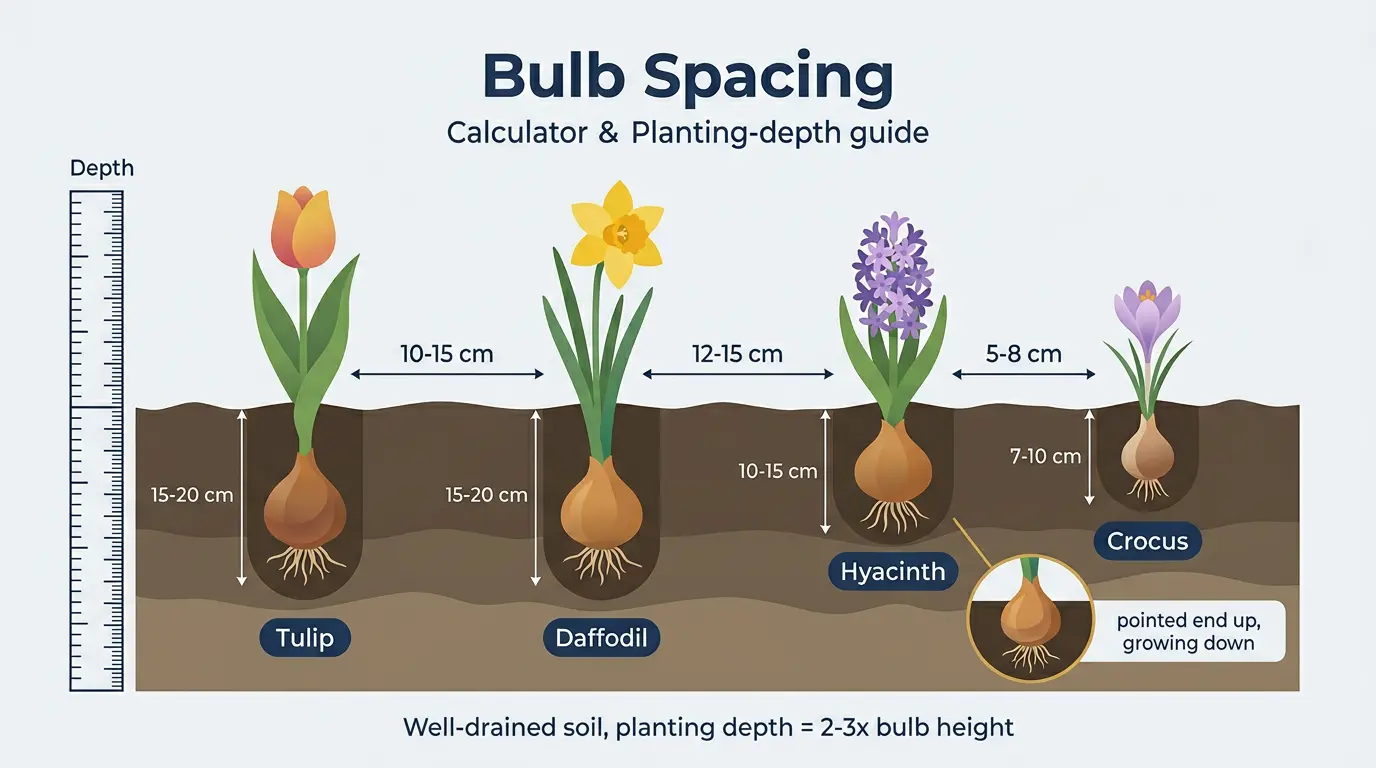
A good rule of thumb is to space bulbs 2–3 times their width apart and plant them 2–3 times their height deep. Larger bulbs like tulips and daffodils need more room and depth than small bulbs like crocus and snowdrops.
| Bulb | Spacing | Planting Depth | Bloom Time |
|---|---|---|---|
| Tulip | 10–15 cm | 15–20 cm | Spring |
| Daffodil | 12–15 cm | 15–20 cm | Spring |
| Crocus | 5–8 cm | 7–10 cm | Early spring |
| Hyacinth | 8–10 cm | 10–15 cm | Spring |
| Allium | 10–15 cm | 15–20 cm | Late spring |
| Dutch Iris | 15–20 cm | 10–15 cm | Late spring |
| Snowdrop | 8 cm | 7–10 cm | Late winter |
| Grape Hyacinth | 5–8 cm | 8–10 cm | Spring |
In cold climates, plant slightly deeper for winter protection; in heavy clay, plant a little shallower to avoid waterlogging.
How Many Bulbs by Bed Size
Use this quick guide to estimate bulb counts for common bed sizes at different spacings (no border margin). Tighter spacing creates a fuller display but uses many more bulbs.
| Bed Size | 10 cm grid | 12 cm grid | 15 cm grid |
|---|---|---|---|
| 1 × 1 m | 100 | 64 | 36 |
| 2 × 1 m | 200 | 128 | 78 |
| 3 × 2 m | 600 | 400 | 260 |
| 4 × 3 m | 1,200 | 825 | 520 |
Adding a border margin reduces these totals — e.g., a 3 × 2 m bed with a 10 cm border holds 504 bulbs on a 10 cm grid, not 600.
Rectangular vs Triangular Planting Patterns
Bulbs can be planted on a simple square grid or an offset (triangular) grid. Triangular planting staggers each row by half a space, fitting roughly 15% more bulbs in the same area while looking more natural.
- Rectangular grid:
simple rows and columns — easiest to lay out
- Triangular grid:
offset rows — ~15% denser, more natural drifts
- Clusters:
odd-numbered groups of 5–15 for an informal look
- Formal beds:
tight, uniform grids for blocks of solid color
For a meadow or 'naturalized' look, scatter bulbs by hand and plant them where they land instead of using a strict grid.
When to Plant Flower Bulbs
Timing depends on when the bulb blooms. Spring-flowering bulbs need a cold dormant period, so they go in during autumn; summer bloomers go in after the last frost.
Spring bloomers (tulip, daffodil, crocus): plant in autumn, 6–8 weeks before hard frost
Summer bloomers (dahlia, gladiolus, lily): plant in spring after the last frost
Soil temperature below 15 °C (60 °F) is ideal for autumn planting
In mild climates, pre-chill tulip and hyacinth bulbs for 8–12 weeks
Planting Tips for Best Results
Successful bulbs come down to depth, spacing, and drainage. For soil preparation, see our soil calculator and fertilizer calculator.
Plant pointed end UP — the flat root plate goes down
Plant at a depth of 2–3 times the bulb's height
Add bone meal or bulb fertilizer at planting time
Water well after planting, then mulch to retain moisture
Avoid waterlogged soil — most bulbs rot in standing water
If you can't tell which end is up, plant the bulb on its side — the shoot will still find its way to the surface.
Common Bulb-Planting Mistakes
A few avoidable errors account for most disappointing bulb displays. Watch for these.
Planting too shallow — bulbs heave out of the soil and dry out
Overcrowding — competition shrinks flowers and spreads disease
Planting upside down or in soggy soil
Skipping the autumn window for spring bloomers
Cutting back foliage before it yellows, starving next year's bulb
Let foliage die back naturally after blooming — the leaves recharge the bulb for the following year.
Naturalizing and Long-Term Care
Many bulbs 'naturalize', multiplying and spreading over the years if given room. Spacing them a little farther apart at planting leaves space for offsets to form, so the display improves rather than crowds itself out.
Daffodils, crocus, and snowdrops naturalize especially well
Lift and divide congested clumps every 3–5 years
Feed with a low-nitrogen bulb fertilizer after flowering
Leave undisturbed where possible — bulbs dislike frequent moving
Plant naturalizing bulbs a touch farther apart than the minimum so new offset bulbs have room to grow.
Quick Reference Card
Bulb Spacing — Quick Reference
Quick reference • Bulb Spacing Calculator
Bulbs = ⌊(L−2b)/sₚ⌋ × ⌊(W−2b)/s_r⌋ (L, W in m; spacing in cm)Valid range: Bed 0.1–100 m; spacing & border 1–100 cm
Common Values
⚠ Watch Out
- •Overcrowding causes smaller flowers, disease, and shorter bulb life
- •Avoid waterlogged soil — most bulbs rot in standing water
- •Match spacing to species; large bulbs need more room than small ones
Pro Tips
- →Plant pointed end up; depth = 2–3× the bulb's height
- →Use a triangular/offset grid to fit ~15% more bulbs naturally
- →Group in odd-numbered clusters of 5–15 for a natural look
FAQs
How far apart should I plant flower bulbs?
It depends on the species: tulips 10–15 cm, daffodils 12–15 cm, crocus 5–8 cm, hyacinths 8–10 cm. A general rule is 2–3 times the bulb's width. Closer spacing creates a denser display but can reduce longevity.
How many bulbs do I need per square meter?
On a 10 cm grid you fit about 100 bulbs per square meter; on a 12 cm grid roughly 64; on a 15 cm grid about 36. Enter your exact bed size and spacing above for a precise count that also accounts for the border margin.
How deep should I plant bulbs?
The general rule is 2–3 times the height of the bulb. Tulips and daffodils go 15–20 cm deep; crocus and snowdrops 7–10 cm. In cold climates, plant slightly deeper for winter protection.
Can I plant bulbs too close together?
Yes. Overcrowded bulbs compete for nutrients and water, leading to smaller flowers, higher disease risk, and shorter lifespan. Follow the recommended spacing for the best long-term results.
Should I plant bulbs in rows or clusters?
Both work. Formal beds use uniform grids for blocks of solid color, while informal gardens look best with odd-numbered clusters of 5–15 bulbs. An offset (triangular) grid fits about 15% more bulbs and looks more natural than straight rows.
When is the best time to plant bulbs?
Spring-flowering bulbs (tulips, daffodils, crocus) are planted in autumn, 6–8 weeks before the first hard frost. Summer-flowering bulbs (dahlias, gladiolus) are planted in spring after the last frost.
Which end of the bulb goes up?
Plant the pointed end up and the flat 'root plate' down. If you genuinely can't tell, plant the bulb on its side — the shoot will still grow upward and the roots downward.
Do bulbs multiply over time?
Many do. Daffodils, crocus, and snowdrops naturalize, forming offset bulbs that spread the display over the years. Leaving a little extra spacing at planting gives new offsets room to grow before clumps get congested.
Can I plant bulbs in pots or containers?
Yes. In containers you can space bulbs more tightly — almost touching — for a full display, since the pot is replanted each season. Ensure good drainage and use the same depth guidance of 2–3 times the bulb height.