Last updated: May 24, 2026
Acres Per Hour Calculator

Creators
Dharmendra SinghReviewers
Creators
Dharmendra SinghReviewers
Quick Answer
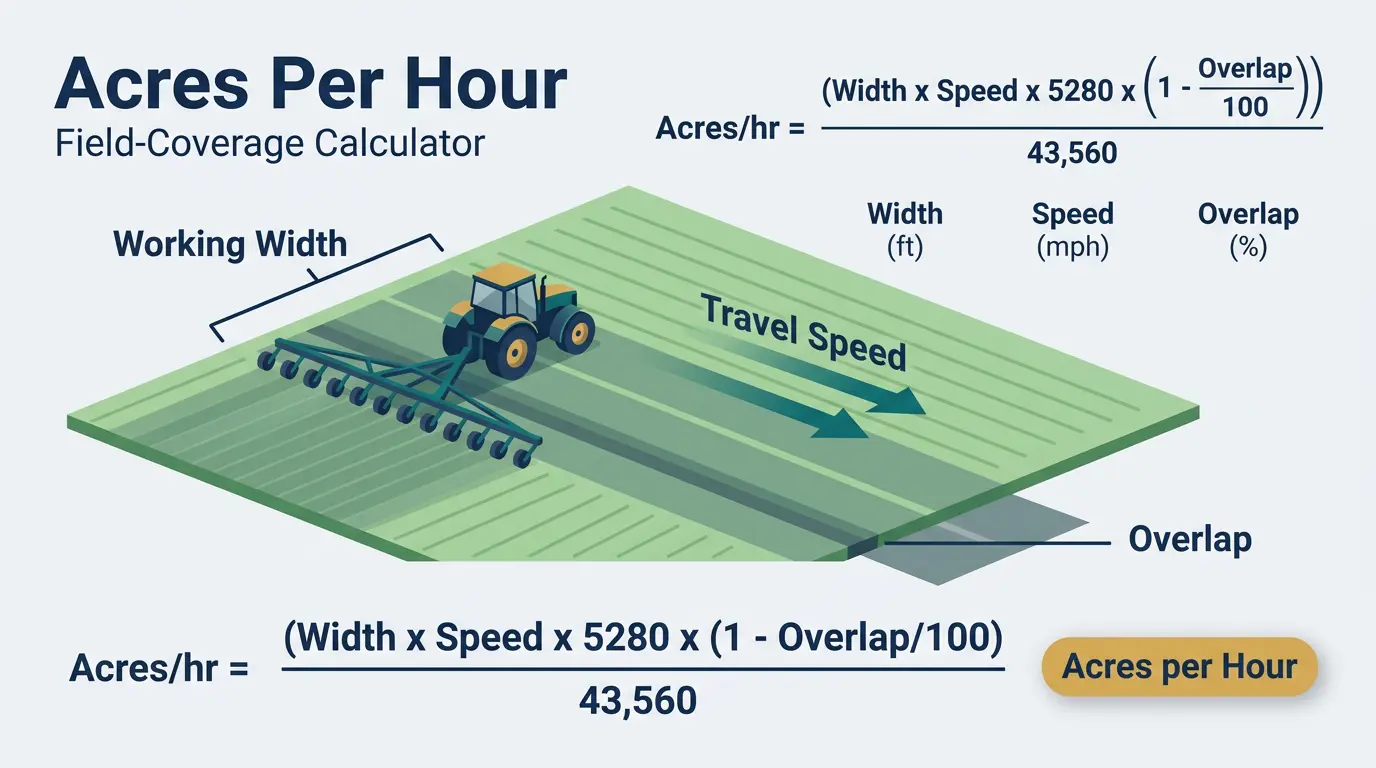
Calculate field coverage rate based on equipment width, speed, and overlap for agricultural and landscaping operations. The formula used is Acres/hr = (Width × Speed × 5280 × (1 − Overlap/100)) / 43560.
Calculate field coverage rate based on equipment width, speed, and overlap for agricultural and landscaping operations.
Key Takeaways
- The core formula is Acres/hr = (Width × Speed × 5280 × (1 − Overlap/100)) / 43560
- The Acres Per Hour Calculator determines how many acres of farmland you can cover per hour based on equipment width and travel speed.
- Width × Speed gives the raw area covered per time unit
- Push mower (22 in, 3 mph): ~0.5 acres/hour
- 0% overlap: GPS-guided sprayers and precision planters with auto-steer
- Example: Riding Mower — Residential Lawn yields 1.91 ac/hr
Creators
Dharmendra SinghReviewers
Creators
Dharmendra SinghReviewers
Formula
Acres/hr = (Width × Speed × 5280 × (1 − Overlap/100)) / 43560
Where:
- W=Effective implement width(feet)
- S=Travel speed(mph)
- O=Overlap percentage(%)
- 5280=Feet per mile (conversion)
- 43560=Square feet per acre (conversion)
Worked Examples
Riding Mower — Residential Lawn
A 42-inch (3.5 ft) riding mower at 5 mph with 10% overlap
- 1Effective width = 3.5 × (1 − 10/100) = 3.15 ft
- 2Distance per hour = 5 × 5,280 = 26,400 ft
- 3Area per hour = 3.15 × 26,400 = 83,160 sq ft
- 4Acres per hour = 83,160 / 43,560 = 1.91 ac/hr
Combine Harvester — Grain Field
A 30-foot combine header at 5 mph with 0% overlap
- 1Effective width = 30 ft (no overlap)
- 2Distance per hour = 5 × 5,280 = 26,400 ft
- 3Area per hour = 30 × 26,400 = 792,000 sq ft
- 4Acres per hour = 792,000 / 43,560 = 18.18 ac/hr
Introduction
The Acres Per Hour Calculator determines how many acres of farmland you can cover per hour based on equipment width and travel speed. Whether you are planning field operations with a plant spacing calculator or estimating fertilizer needs, knowing your coverage rate is essential for efficient farm management.
How the Calculation Works
The acres-per-hour formula calculates the area swept by your implement per unit time. It multiplies effective working width by ground speed, then converts from square feet to acres. This method follows ASABE Standard EP496 for agricultural machinery field capacity measurement.
Width × Speed gives the raw area covered per time unit
Overlap reduces effective width — 10% overlap means only 90% of width counts
The constant 43,560 converts square feet to acres
The constant 5,280 converts miles to feet
Real-world efficiency is typically 70-85% of calculated capacity due to turns, stops, and terrain. Multiply by 0.75 for job estimation.
Typical Equipment Coverage Rates
Different agricultural and landscaping equipment operates at different widths and speeds. Here are typical coverage rates for common implements.
- Push mower (22 in, 3 mph):
~0.5 acres/hour
- Riding mower (42 in, 5 mph):
~1.9 acres/hour
- Zero-turn mower (60 in, 7 mph):
~4.2 acres/hour
- Field cultivator (30 ft, 8 mph):
~29 acres/hour
- Combine harvester (30 ft, 5 mph):
~18 acres/hour
- Boom sprayer (60 ft, 12 mph):
~87 acres/hour
- Grain drill (15 ft, 6 mph):
~11 acres/hour
| Equipment | Working Width | Typical Speed | Approx. Coverage (theoretical) |
|---|---|---|---|
| Push mower | 22 in (1.83 ft) | 3 mph | ~0.5 ac/hr |
| Riding mower | 42 in (3.5 ft) | 5 mph | ~1.9 ac/hr |
| Zero-turn mower | 60 in (5 ft) | 7 mph | ~4.2 ac/hr |
| Grain drill | 15 ft | 6 mph | ~11 ac/hr |
| Combine harvester | 30 ft | 5 mph | ~18 ac/hr |
| Field cultivator | 30 ft | 8 mph | ~29 ac/hr |
| Boom sprayer | 60 ft | 12 mph | ~87 ac/hr |
Values assume 0% overlap and 100% field efficiency. Multiply by your field efficiency (typically 0.70–0.85) for realistic job estimates.
Choosing the Right Overlap Percentage
Overlap ensures complete coverage with no gaps. The right amount depends on equipment precision and consequences of missing a strip.
- 1
0% overlap: GPS-guided sprayers and precision planters with auto-steer
- 2
2-5% overlap: Seeding and planting with good guidance systems
- 3
5-10% overlap: Mowing, cultivating, and discing with manual steering
- 4
10-15% overlap: Push mowing on uneven terrain without reference lines
- 5
15-20% overlap: Broadcast spreading where gaps are unacceptable
Field Efficiency Factors
The theoretical acres-per-hour represents maximum capacity. In practice, you will achieve 60-85% due to real-world factors.
- Turns at headlands:
Short fields require more turns, reducing efficiency to 60-70%
- Refueling and refilling:
Sprayers and spreaders need periodic stops
- Terrain and obstacles:
Hills, trees, fences reduce average speed
- Operator fatigue:
Efficiency drops after 4-6 hours of continuous operation
- Field shape:
Irregularly shaped fields have more non-productive turning time
For job bidding, multiply your calculated rate by 0.75 (75% field efficiency) as a conservative starting point.
Real-World Applications in Agriculture
Field capacity calculations drive critical decisions in modern agriculture — from equipment purchasing to labor scheduling and contract pricing. Understanding your actual coverage rate helps optimize every aspect of field operations.
- Equipment purchasing:
Compare tractors and implements by their effective acres/hour before investing
- Labor scheduling:
Calculate how many hours or days a crew needs to cover a given acreage
- Contract pricing:
Landscaping and custom farming businesses price jobs based on acres/hour rates
- Fuel budgeting:
Combine coverage rate with fuel consumption to estimate cost per acre
- Seasonal planning:
Plan planting and harvest windows by knowing daily coverage capacity
Always account for field efficiency (typically 70-85%) when planning. A calculator showing 10 ac/hr theoretical means ~7.5 ac/hr in real field conditions due to turns, refueling, and obstacles.
GPS and Precision Agriculture
Modern GPS-guided equipment has revolutionized field coverage by virtually eliminating overlap waste and enabling precise pass-to-pass accuracy. Auto-steer systems maintain sub-inch accuracy, allowing operators to reduce overlap from 10-15% down to near 0%.
- RTK GPS auto-steer:
Provides ±1 inch pass-to-pass accuracy, virtually eliminating overlap
- Section control:
Automatically shuts off sprayer booms or planter rows in already-covered areas
- Variable rate technology (VRT):
Adjusts application rates based on GPS-mapped field zones
- Yield mapping:
Records actual harvest rates per area for future planning
- Telematics:
Real-time tracking of equipment speed, coverage, and efficiency
With GPS auto-steer, you can safely set overlap to 0% in this calculator. Without GPS, use 5-15% depending on your equipment and terrain. The difference between 0% and 10% overlap on a 60-foot sprayer saves approximately 8.7 acres per hour.
Common Mistakes to Avoid
Field-capacity estimates go wrong in predictable ways. Avoiding these mistakes keeps your acres-per-hour numbers realistic for planning and bidding.
- Mixing units:
width must be in feet and speed in mph. Divide inches by 12 first (42 in = 3.5 ft)
- Ignoring overlap:
manual steering wastes 5–15% of width — leaving overlap at 0% overstates coverage
- Forgetting field efficiency:
theoretical capacity assumes non-stop straight passes; real jobs run at 70–85%
Using header width instead of cut width on combines with auto-steer and partial passes
- Quoting jobs at theoretical capacity:
always discount by your field efficiency before pricing
A quick sanity check: a 60-ft implement at 5 mph covers roughly 36 ac/hr at 100% efficiency — if your estimate is wildly different, re-check your units.
Field Capacity Glossary
Key terms used in agricultural field-capacity calculations:
| Term | Definition |
|---|---|
| Effective working width | The actual width covered per pass after subtracting pass-to-pass overlap. |
| Theoretical field capacity | Acres covered per hour at full speed with no overlap, turns, or stops (100% efficiency). |
| Effective field capacity | The real acres-per-hour achieved after turns, refills, and overlap — theoretical × field efficiency. |
| Field efficiency | Ratio of productive time to total field time, typically 60–85%. |
| Overlap | The fraction of implement width that re-covers an already-worked strip to avoid gaps. |
| Swath | A single pass of the implement across the field. |
| Headland | The strip at field ends used for turning; a major source of lost efficiency on short fields. |
Quick Reference Card
Acres Per Hour Calculator — Quick Reference
Quick reference • Acres Per Hour Calculator
Acres/hr = (Width × Speed × 5280 × (1 − Overlap/100)) / 43560Valid range: Input range: 0.1 – 50
Common Values
⚠ Watch Out
- •For job bidding, multiply your calculated rate by 0.75 (75% field efficiency) as a conservative star
- •Always account for field efficiency (typically 70-85%) when planning. A calculator showing 10 ac/hr
Pro Tips
- →Real-world efficiency is typically 70-85% of calculated capacity due to turns, stops, and terrain. M
- →With GPS auto-steer, you can safely set overlap to 0% in this calculator. Without GPS, use 5-15% dep
FAQs
How do I calculate acres per hour for my mower?
Measure your mowing deck width in feet (divide inches by 12), determine your typical mowing speed in mph, and enter your overlap percentage (typically 10%). The formula is: Acres/hr = Width(ft) × Speed(mph) × 5280 / 43560 × (1 − Overlap/100).
What is a good acres-per-hour rate for lawn mowing?
It depends on equipment: a push mower covers about 0.5 acres/hour, a riding mower 1.5-2.5 acres/hour, and a commercial zero-turn mower 3-5 acres/hour.
Why do I need overlap when mowing or spraying?
Overlap ensures complete coverage with no missed strips. Without overlap, slight steering errors leave untreated gaps. GPS auto-steer can reduce overlap to near 0%, but manual operation typically requires 5-15%.
How does field efficiency differ from theoretical capacity?
Theoretical capacity assumes non-stop straight-line operation. Field efficiency accounts for turning, refueling, obstacles, and breaks. Typical: 60% for small irregular fields, 85% for large flat rectangular fields.
How long will it take to mow my lawn?
Divide your lawn size (acres) by your acres-per-hour rate. Example: 1-acre lawn with a 42-inch riding mower at 5 mph (10% overlap) = 1 / 1.91 = 0.52 hours (about 31 minutes). Add 15-20% for turns.
What is field efficiency and how do I calculate it?
Field efficiency is the ratio of actual productive time to total time in the field, expressed as a percentage. It accounts for turning at headlands, refueling, adjustments, and breaks. Calculate it as: Efficiency = (actual acres covered / theoretical acres capacity) × 100. Typical values: 60-70% for small irregular fields, 75-80% for medium rectangular fields, 80-85% for large flat fields with GPS guidance.
How do I convert between different width units?
Common conversions: divide inches by 12 to get feet (e.g., 42 inches = 3.5 feet), multiply meters by 3.281 to get feet, multiply centimeters by 0.0328 to get feet. For speed: 1 mph = 1.467 ft/s = 1.609 km/h. Always convert all measurements to consistent units (feet and mph) before calculating.
How do I convert acres per hour to hectares per hour?
Divide acres per hour by 2.47105 (since 1 hectare = 2.47105 acres). For example, 18.18 ac/hr ÷ 2.47105 = 7.36 ha/hr. This calculator shows both units automatically, so you can plan in whichever system you use.
Does increasing speed or width improve coverage more?
Both scale coverage linearly, but width is usually the better lever. Going from a 30-ft to a 60-ft implement doubles capacity with no extra fuel per acre, while higher speeds are limited by ride quality, soil conditions, and implement performance. Most operators max out practical speed long before they max out usable width.
How many acres can I cover in an 8-hour day?
Multiply your acres-per-hour rate by 8, then apply field efficiency. For example, an 18 ac/hr combine at 75% efficiency covers about 18 × 8 × 0.75 = 108 acres per day. This calculator reports the theoretical acres-per-day figure so you can apply your own efficiency factor.
Why is my real-world coverage lower than the calculator shows?
The calculator reports theoretical capacity — non-stop, straight-line operation. In practice you lose time to turning at headlands, refilling seed/spray/fuel, obstacles, and operator breaks. Real field efficiency is typically 60-85%, so multiply the result by 0.70-0.85 for a realistic estimate.