Last updated: May 24, 2026
Basal Area Calculator

Creators
Dharmendra SinghReviewers
Creators
Dharmendra SinghReviewers
Quick Answer
Calculate the cross-sectional area of a tree trunk at breast height (DBH) for forestry inventory, timber estimation, and stand density analysis. The formula used is BA = 0.005454 × DBH² (imperial) or BA = 0.00007854 × DBH² (metric).
Calculate the cross-sectional area of a tree trunk at breast height (DBH) for forestry inventory, timber estimation, and stand density analysis.
Key Takeaways
- The core formula is BA = 0.005454 × DBH² (imperial) or BA = 0.00007854 × DBH² (metric)
- The Basal Area Calculator computes the cross-sectional area of a tree trunk at breast height (4.5 feet / 1.37 meters above ground).
- Single tree: BA = 0.005454 × DBH² (inches → ft²)
- Measure at 4.5 ft (1.3 m) above ground on the uphill side
- Under 10 ft²/acre: Very sparse — regeneration phase or savanna
- Example: Single Oak Tree — 12-inch DBH yields 0.7854 ft²
Creators
Dharmendra SinghReviewers
Creators
Dharmendra SinghReviewers
Formula
BA = 0.005454 × DBH² (imperial) or BA = 0.00007854 × DBH² (metric)
Where:
- BA=Basal area(ft² or m²)
- DBH=Diameter at breast height (4.5 ft / 1.3 m)(inches or cm)
- 0.005454=Constant for imperial units (π/4 × 1/144)
- 0.00007854=Constant for metric units (π/4 × 1/10000)
Worked Examples
Single Oak Tree — 12-inch DBH
Calculate the basal area of an oak tree with a 12-inch diameter at breast height
- 1BA = 0.005454 × DBH²
- 2BA = 0.005454 × 12²
- 3BA = 0.005454 × 144
- 4BA = 0.7854 ft²
Forest Inventory Plot — 10 Trees on 0.1 Acre
Ten trees with average 14-inch DBH on a 1/10-acre sample plot
- 1BA per tree = 0.005454 × 14² = 1.069 ft²
- 2Total BA = 1.069 × 10 = 10.69 ft²
- 3BA per acre = 10.69 / 0.1 = 106.9 ft²/acre
Large Old-Growth Douglas Fir — 36-inch DBH
Calculate basal area of a large old-growth tree
- 1BA = 0.005454 × 36²
- 2BA = 0.005454 × 1296
- 3BA = 7.069 ft²
Introduction
The Basal Area Calculator computes the cross-sectional area of a tree trunk at breast height (4.5 feet / 1.37 meters above ground). Basal area is a key metric in forestry and ecology for estimating timber volume, stand density, and forest health. For related measurements, see our tree height calculator and tree diameter calculator.
What is Basal Area?
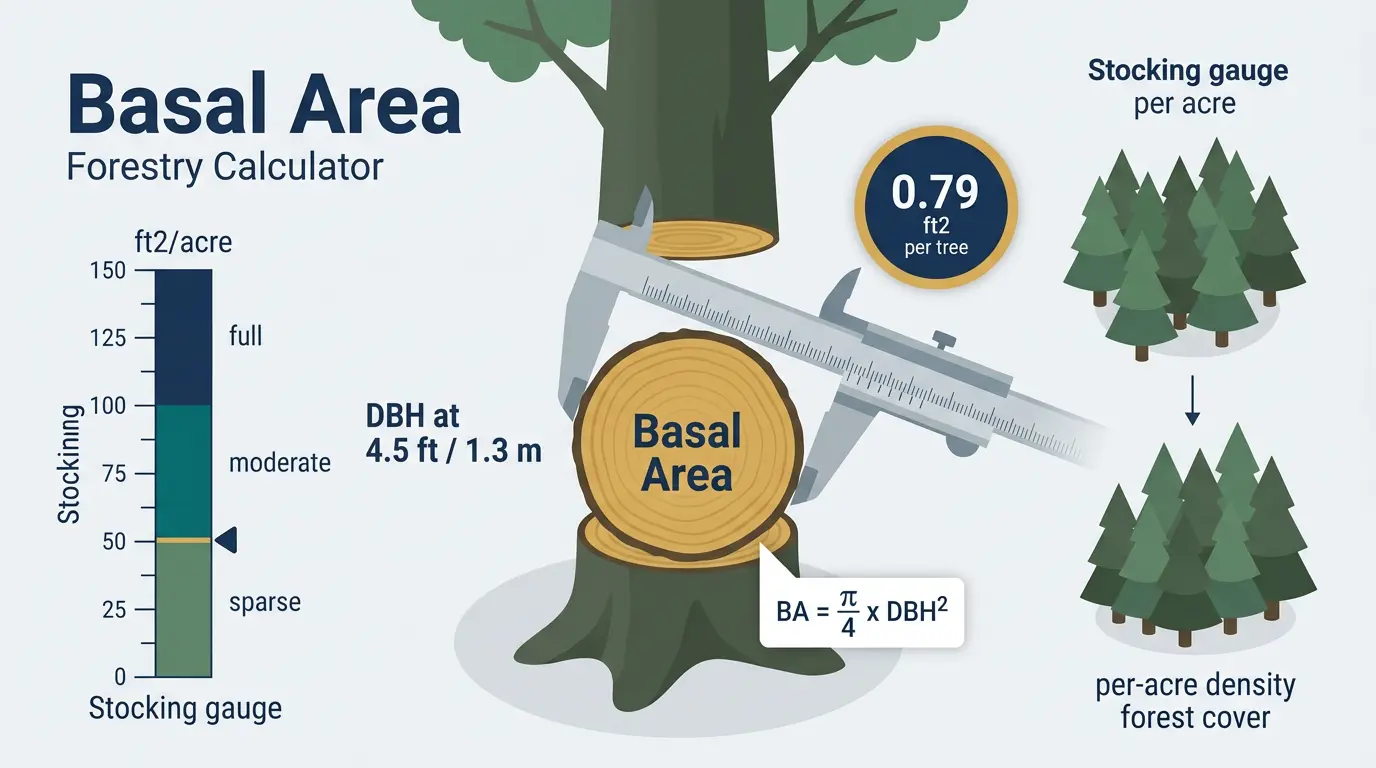
Basal area is the cross-sectional area of a tree stem at breast height (4.5 ft / 1.3 m above ground). It is expressed in square feet (imperial) or square meters (metric). At the stand level, basal area per acre (or per hectare) is the sum of all individual tree basal areas on that area — the single most useful measure of forest density.
- Single tree:
BA = 0.005454 × DBH² (inches → ft²)
- Single tree:
BA = 0.00007854 × DBH² (cm → m²)
- Stand level:
Sum of all individual tree BAs on the plot
- Per acre/hectare:
Total BA ÷ plot size
DBH is always measured at 4.5 ft (1.3 m) above ground on the uphill side
The constant 0.005454 comes from π/4 × 1/144, which converts diameter in inches to area in square feet. For metric, 0.00007854 = π/4 × 1/10,000 converts cm to m².
How to Measure DBH Correctly
Accurate DBH measurement is critical for reliable basal area calculations. The standard measurement point is 4.5 feet (1.3 m) above ground level on the uphill side of the tree. Use a diameter tape (D-tape) or calipers for best accuracy.
Measure at 4.5 ft (1.3 m) above ground on the uphill side
Use a diameter tape (D-tape) for direct diameter reading, or a standard tape and divide circumference by π
For leaning trees: measure 4.5 ft along the lean, not vertically
For forked trees: if fork is below 4.5 ft, measure each stem separately
For trees on slopes: always measure from the uphill side
For trees with buttress roots or swelling: measure above the irregularity
A diameter tape reads diameter directly from circumference. If using a regular tape, divide the circumference by 3.14159 to get diameter. Example: 37.7 inches circumference ÷ π = 12 inches DBH.
Interpreting Stand Basal Area
Basal area per acre is the primary metric for assessing forest stand density. Different management objectives require different target densities. The values below are for the eastern United States; western forests and tropical forests may have different ranges.
- Under 10 ft²/acre:
Very sparse — regeneration phase or savanna
- 10–20 ft²/acre:
Open woodland — young plantations or heavily thinned stands
- 20–40 ft²/acre:
Moderate density — typical well-managed pine plantation
- 40–60 ft²/acre:
Moderate to full stocking — mature mixed hardwood forest
- 60–80 ft²/acre:
Fully stocked — dense hardwood or old-growth forest
- 80–120 ft²/acre:
Overstocked — dense old-growth, may need thinning
- Over 120 ft²/acre:
Heavily overstocked — high competition, stress, fire risk
Target basal area depends on species, site quality, and management goals. Southern pine plantations target 60–80 ft²/ac for timber; wildlife habitat may target 40–60 ft²/ac for understory growth.
Applications in Forest Management
Basal area drives decision-making across virtually every aspect of forest management — from timber cruising and harvest planning to wildlife habitat assessment and fire risk evaluation.
- Timber cruising:
Estimate board-foot volume from BA using volume tables
- Harvest planning:
Determine which trees to remove in thinning operations
- Growth monitoring:
Track stand development over time with periodic measurements
- Wildlife habitat:
Manage stand density for target species (e.g., open canopy for ground-nesting birds)
- Fire management:
Higher BA = more fuel load = higher fire risk in dry conditions
- Carbon estimation:
BA correlates strongly with above-ground biomass and carbon storage
Basal Area Factor (BAF) and Prism Cruising
The basal area factor (BAF) is used with a wedge prism or angle gauge to rapidly estimate stand basal area without measuring every tree. The forester looks through the prism at each tree from a sample point — trees that appear wider than the prism offset are counted as “in.” Each “in” tree equals the BAF value in ft²/acre.
- BAF 10:
Each counted tree = 10 ft²/acre (most common for hardwoods)
- BAF 5:
Each counted tree = 5 ft²/acre (young or sparse stands)
- BAF 20:
Each counted tree = 20 ft²/acre (dense stands, fast cruising)
- Example:
BAF 10 prism, you count 8 trees = 80 ft²/acre basal area
Prism cruising is accurate to ±10% with proper technique and sufficient sample points
For a quick estimate without a prism: extend your arm and hold a credit card vertically at arm's length. A tree that appears wider than the card at ~25 inches from your eye has a DBH roughly corresponding to a BAF-10 “in” tree.
Typical DBH and Basal Area by Tree Species
Different tree species grow at different rates and reach different maximum sizes. Knowing typical DBH ranges helps you evaluate whether individual trees and stands are developing normally.
- White Oak:
Mature DBH 18–36″, BA 1.8–7.1 ft², slow-growing (80+ years to maturity)
- Loblolly Pine:
Mature DBH 12–24″, BA 0.8–3.1 ft², fast-growing plantation species
- Douglas Fir:
Mature DBH 24–60″, BA 3.1–19.6 ft², premier western timber species
- Sugar Maple:
Mature DBH 18–30″, BA 1.8–4.9 ft², valuable hardwood
- Paper Birch:
Mature DBH 8–16″, BA 0.3–1.4 ft², short-lived pioneer species
- Coast Redwood:
Mature DBH 48–180″, BA 12.6–176.7 ft², world's tallest trees
Quick Reference Card
Basal Area Calculator — Quick Reference
Quick reference • Basal Area Calculator
BA = 0.005454 × DBH² (imperial) or BA = 0.00007854 × DBH² (metric)Valid range: See input constraints
Common Values
⚠ Watch Out
- •The constant 0.005454 comes from π/4 × 1/144, which converts diameter in inches to area in square fe
- •Target basal area depends on species, site quality, and management goals. Southern pine plantations
Pro Tips
- →A diameter tape reads diameter directly from circumference. If using a regular tape, divide the circ
- →For a quick estimate without a prism: extend your arm and hold a credit card vertically at arm's len
FAQs
What is DBH and how do I measure it?
DBH stands for Diameter at Breast Height — the diameter of a tree trunk measured at 4.5 feet (1.3 meters) above ground level. Use a diameter tape (D-tape) wrapped around the trunk, or measure circumference with a regular tape and divide by π (3.14159). Always measure from the uphill side on slopes.
Why is basal area measured at breast height?
Breast height (4.5 ft / 1.3 m) was chosen because it is above most root flare and buttress irregularities, provides a consistent and reproducible measurement point, and is at a comfortable height for field measurement. This standard was established by the USDA Forest Service and is used worldwide.
What is a good basal area per acre?
It depends on your management goals and tree species. For timber production in pine plantations, 60–80 ft²/acre is optimal. For hardwood forests managed for wildlife, 40–60 ft²/acre provides good understory development. Old-growth forests may exceed 120 ft²/acre. Under 20 ft²/acre is considered sparse.
How do I convert between imperial and metric basal area?
For individual trees: 1 ft² = 0.0929 m². For stand density: 1 ft²/acre = 0.2296 m²/hectare. To convert DBH: 1 inch = 2.54 cm. The metric formula uses the constant 0.00007854 instead of the imperial 0.005454.
What is a basal area factor (BAF)?
BAF is a constant used with a wedge prism or angle gauge for rapid stand-level basal area estimation. Each tree that appears wider than the prism offset from a sample point counts as one BAF unit. With a BAF-10 prism, counting 7 trees means the stand has approximately 70 ft²/acre basal area.
Can I use this calculator for urban trees?
Yes. The formula works for any tree regardless of setting. Urban foresters use basal area to assess tree canopy coverage, estimate ecosystem services (carbon sequestration, stormwater management), and plan maintenance. Note that urban trees often have irregular forms due to pruning.
How does basal area relate to board feet of lumber?
Basal area correlates with timber volume but the relationship depends on tree height and form. Foresters use volume tables (e.g., Doyle, Scribner, or International 1/4″ rules) that take both DBH and merchantable height as inputs. As a rough guide: a tree with 1 ft² BA and 40 ft merchantable height contains approximately 100–200 board feet.